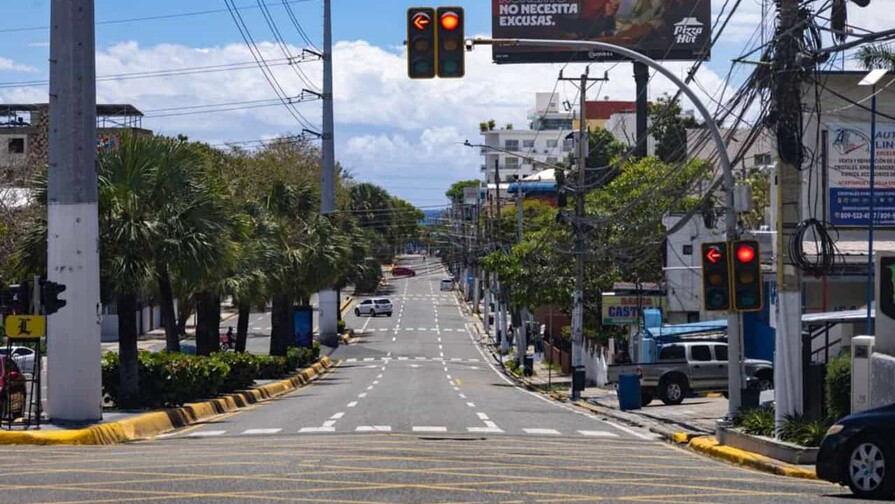
On Holy Saturday, Greater Santo Domingo’s normally vibrant urban landscape fell into an unusual, profound stillness. The sprawling capital’s streets, avenues and residential neighborhoods, which typically hum with daily commerce and movement, saw a sharp drop in activity, with sparse traffic, empty thoroughfares, and most businesses shuttered for the religious holiday.
Following the mandatory full shutdown of public life on Good Friday, the traditional period of religious reflection extended into Holy Saturday, bringing a near-total pause to routine commercial activity. Once-bustling corridors were reduced to a quiet lethargy, with foot traffic and vehicle movement dropping far below typical weekend levels. Nearly all retail shops, beauty salons, and non-essential service businesses remained closed for the observance, leaving only limited operations for food-focused establishments to serve residents who stayed in the capital over the holiday. Grocery stores, small local food vendors, and roadside fried food stands were among the only businesses welcoming customers.
Streets lined with parked cars signal that most locals opted to stay home for the holiday, with the usual city soundtrack of honking horns and blaring music entirely absent. Even Santo Domingo’s iconic Malecón, the waterfront boardwalk that usually draws crowds of locals and visitors, remained nearly deserted. Salt air drifted across the quiet promenade, where the ocean lay calm with barely a ripple, and only small groups gathered to chat on benches or complete casual exercise on foot or bicycle.
Across residential neighborhoods, residents adapted to the slow holiday pace in small, personal ways. In Ensanche Espaillat, local resident Fiordaliza Capellán set up two inflatable swimming pools outside her home for her grandchildren to enjoy, noting that police had removed an identical setup the day before in an adjacent street. Unlike many local families, Capellán opted not to prepare the traditional holiday dish sweet beans this year, citing both the high cost of the ingredient and the large volume she would need to make to share with neighborhood friends. She did, however, keep the tradition of preparing fish for Good Friday. The high price of sweet beans was a common complaint across the city: on Diego Colón Street in Los Mina, an unidentified local resident voiced frustration over the inflated cost of the staple holiday ingredient.
For other locals, the quiet holiday brought unhurried, low-key celebration. Roberto, a Los Mina resident, joked that his Good Friday plans centered on generous amounts of rum, a tradition he planned to continue through Holy Saturday, noting that a nearby private club charged only 200 pesos for adult entry to its swimming pool, with free admission for children under five.
In the Villas Agrícolas neighborhood near Nicolás de Ovando Avenue, community members came together to build a makeshift public cooling station on the sidewalk, running three shower pipes connected to a shared water pump where neighborhood children and adults could cool off in the warm holiday weather. Longtime local resident Sandino Henríquez, who has lived in the area for more than 60 years, explained that the group removes the shower heads each night to prevent theft by water truck operators. On Saturday, Henríquez gathered with neighbors to share bread topped with avocado and tuna, while local youth prepared pots to cook a communal meal of fish, rice, and beans later in the day. “We don’t have many plans, just drinks, food, and turning on the shower for a dip,” Henríquez said.
Despite the near-standstill of daily activity, law enforcement and security agencies maintained a heavy visible presence across the capital, continuing patrols and monitoring to preserve public order throughout the holiday. Police officers conducted routine stops and checks across the city, even as vehicle and pedestrian volumes stayed far below normal.