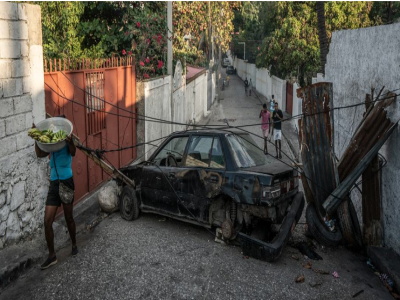
GENEVA, Switzerland – The United Nations issued a grave warning on Friday concerning a dramatic escalation in the systematic recruitment of Haitian children by armed criminal factions, describing the phenomenon as an ‘alarming increase’ with devastating societal repercussions. This development unfolds within a nation gripped by a multidimensional security, humanitarian, and governance catastrophe.
Armed groups now exert control over extensive territories of Port-au-Prince and its surrounding regions, precipitating widespread family displacements and severely restricting civilian access to essential services, including education and healthcare. A new UN report details how escalating poverty and the collapse of social structures are rendering the nation’s youth increasingly vulnerable to exploitation. With approximately 45% of Haiti’s population under the age of 18, children are perceived by these organizations as easily manipulated assets unlikely to arouse suspicion.
The methods of recruitment are both coercive and opportunistic. Many minors, driven by severe economic desperation, hunger, and a lack of educational prospects, are pushed into joining. Others face forcible conscription or direct threats. The report cites harrowing testimonies, such as that of ‘Pierre,’ aged 10, who described being provided with drugs by gang members, leading to addiction and a distorted sense of reality where he ‘felt ready to kill anyone.’
Once enlisted, children are assigned a range of roles that capitalize on their perceived innocence, including acting as lookouts, messengers, and informants. A significant number are also thrust directly into armed conflict, manning checkpoints and participating in kidnappings for ransom—with one child reporting earnings of US$1,000 per week, a staggering sum in a country plagued by extreme poverty.
Girls face particularly egregious risks, enduring sexual exploitation, rape, and being forced into relationships with gang members. ‘Julia,’ a survivor, recounted being sexually assaulted on multiple occasions by members of allied gangs that controlled her neighborhood through a campaign of fear.
The consequences for recruited children are profound and enduring. They experience extreme violence, trauma, and abuse, while their education is irrevocably disrupted. The long-term psychological damage is severe, and the social stigma and fear of retaliation create immense barriers to their reintegration into society.
To counter this crisis, the UN advocates for a multi-faceted response. Key recommendations include the urgent strengthening of child protection systems—which are currently overstretched or nonexistent—and the restoration of access to education. Schools are emphasized as critical safe havens that provide both learning and protection from gang influence. The UN is supporting these efforts through school feeding programs, infrastructure rehabilitation, and cash transfers to vulnerable families.
Furthermore, the report underscores the pivotal role of families, particularly female-headed households, in prevention and calls for increased resources to support them. Local organizations, with UN backing, are implementing vocational training programs to offer youth legitimate employment alternatives to gang life.
The arrival of the new UN-backed Gang Suppression Force (GSF) in April is also highlighted as a pivotal development. This 5,000-strong force is mandated to restore state authority, reduce gang territorial control, secure critical infrastructure, and support Haiti’s path toward elected governance and long-term stability.