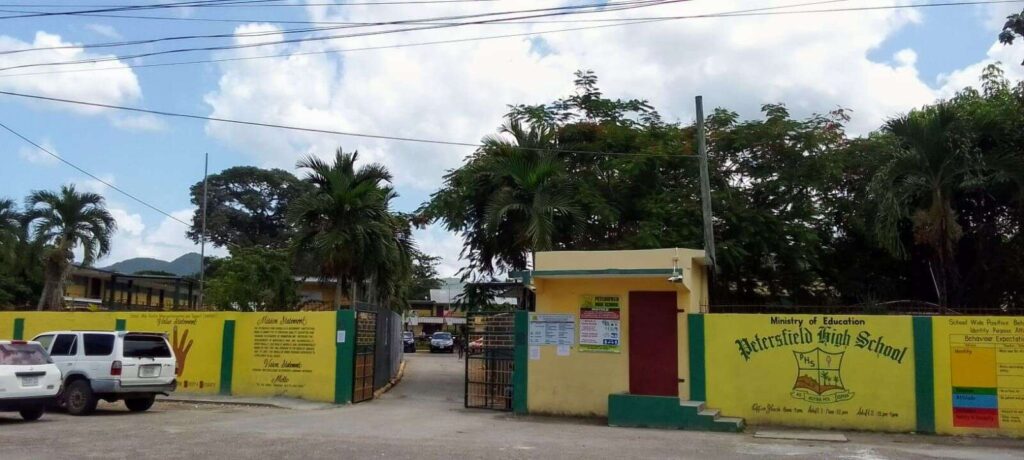
KINGSTON, Jamaica — Student leaders across Jamaica’s Region 4 are demanding urgent governmental action to address the deteriorating learning conditions at Petersfield High School, which continues to operate as an emergency shelter months after Hurricane Melissa devastated the region in October 2025.
The National Secondary Students’ Council (NSSC) Region 4 division issued a formal statement highlighting the critical intersection of humanitarian needs and educational rights. While acknowledging the school’s vital role in providing immediate refuge to displaced families following the catastrophic storm, the council emphasizes that the prolonged dual-use arrangement has created an educational crisis that requires immediate resolution.
Educational operations at Petersfield High have been severely compromised by the ongoing shelter arrangement. The institution already functioned on a shift system prior to the hurricane, but the current situation has exacerbated existing challenges. The continued occupation of an entire grade block has not only halted essential repairs but significantly reduced available classroom space. This spatial constraint has forced administrators to remove certain grade levels from the daily timetable entirely, with core academic subjects now occurring as infrequently as once every fortnight.
Student President Orlando Samuels voiced the collective frustration, stating, ‘Basically, I am not learning. Half of my important classes only occur every two weeks, drastically reducing both instructional time and learning flexibility in ways that are completely unacceptable.’
Beyond logistical constraints, the council reports concerning environmental factors affecting student welfare. Instructional hours are regularly disrupted by residential activities, with noise disturbances and blurred boundaries between living and learning spaces creating significant concentration challenges. More alarmingly, students have reported exposure to inappropriate language and adult conduct occurring in close proximity to minors, raising serious safety and psychological well-being concerns.
Following an extensive campus assessment, Region 4 Assistant Vice President Govaunia James described the environment as ‘not conducive to learning,’ noting observable distractions and concerning reports from the school’s guidance department. ‘While we recognize the humanitarian need for shelter after a crisis,’ James stated, ‘what was intended as a temporary measure is now fundamentally compromising students’ constitutional right to a safe and focused educational environment.’
Region 4 Vice President Rajheim Nelson emphasized the disproportionate impact on students already navigating an compromised shift system. ‘These students are already at a significant disadvantage,’ Nelson explained. ‘Expecting them to learn effectively in an unstable and disruptive environment is unreasonable. While we maintain sympathy for displaced families, it cannot come at the expense of our children’s education.’
The NSSC has proposed a comprehensive four-point intervention plan requiring coordinated governmental response. This includes implementing a clearly defined, time-bound relocation strategy to transition displaced residents into appropriate long-term housing; establishing ministerial coordination to ensure complete classroom accessibility; developing structured academic recovery programs to address substantial instructional time loss; and implementing immediate safeguards to protect students’ psychological and environmental welfare throughout the remaining shelter operation.
‘Education remains the fundamental pillar of national development,’ James concluded. ‘We cannot reasonably expect our future leaders to thrive in an environment never designed to function simultaneously as both an educational institution and a prolonged emergency shelter.’