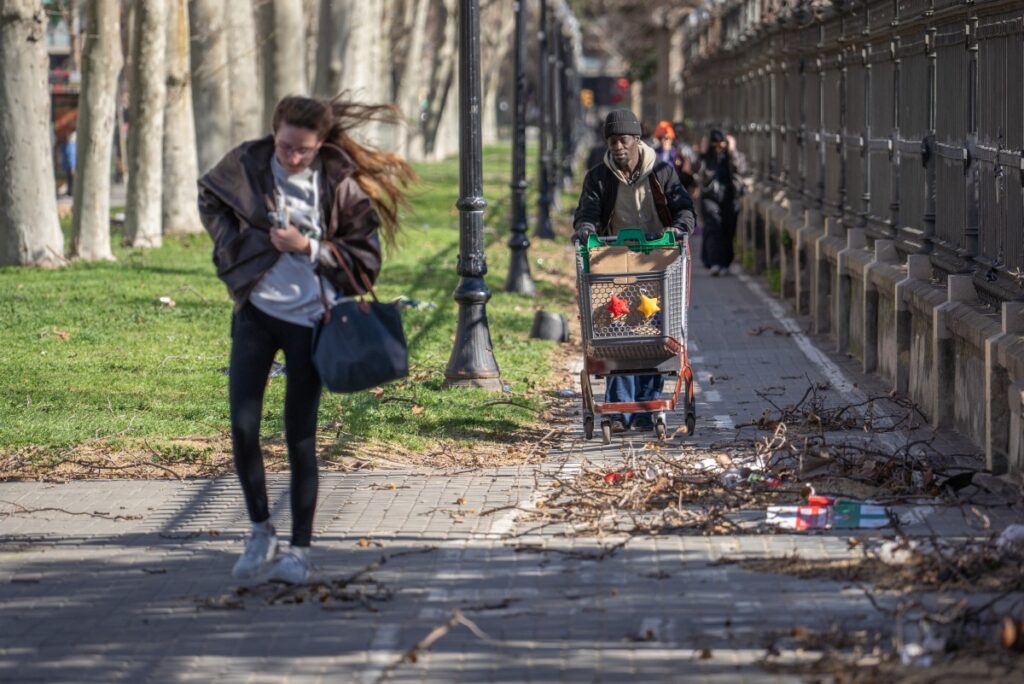
BARCELONA, Spain – Catalonia’s northeastern region endured a severe battering from Storm Nils on Thursday, as ferocious winds exceeding 100 kilometers per hour caused significant damage, injured dozens, and triggered major disruptions to transport and public services. This extreme weather event marks the latest in a series of violent storms to strike the Iberian Peninsula in recent weeks, which have resulted in fatalities and mass evacuations across Spain and Portugal.
According to Catalonia’s civil protection agency, the port of Barcelona recorded particularly devastating gusts reaching 105 km/h. The powerful winds led to toppled trees, collapsed walls, and prompted a surge in emergency response calls across the metropolitan area. Medical services attended to 86 individuals, with 34 requiring hospital admission. Among those hospitalized, two patients were reported in serious condition and one was listed as critical.
The storm’s impact severely disrupted Spain’s transportation infrastructure. At Barcelona-El Prat Airport, the nation’s second busiest aviation hub, operator Aena cancelled 101 flights and diverted 10 others. Additional disruptions were reported on regional road networks and rail lines, compounding the day’s travel chaos.
In response to the exceptional meteorological conditions, which officials described as highly unusual for the region, Catalan authorities implemented widespread precautionary measures. Schools were closed, non-essential medical appointments were postponed, and residents of the eight-million-person region were advised to restrict all non-essential travel until winds were forecast to subside by evening. Regional Interior Department head Nuria Parlon noted that public compliance with travel restrictions likely prevented a higher number of casualties.
The storm system also affected neighboring countries, with Portugal reporting a partially collapsed highway viaduct between Lisbon and Porto after a river overflowed its banks. In southwestern France, the storm proved fatal as a truck driver was killed by a falling tree, while approximately 900,000 households experienced power outages.
Meteorologists and climate scientists increasingly attribute the rising frequency and intensity of such extreme weather episodes to climate change driven by elevated greenhouse gas emissions, highlighting a concerning trend toward more destructive seasonal storms in Southern Europe.