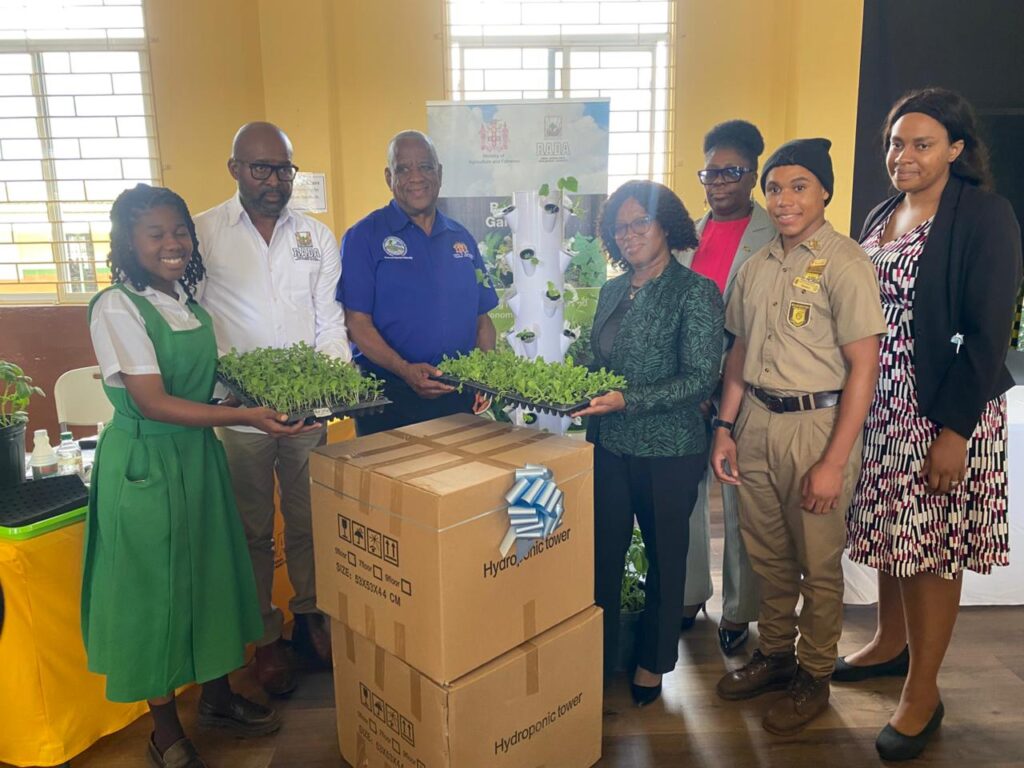
MANCHESTER, Jamaica — A transformative initiative in agricultural education is underway as two secondary institutions in Manchester integrate cutting-edge vertical hydroponic farming systems into their curricula. Manchester High and Holmwood Technical High officially received this advanced agricultural technology during a formal handover ceremony held in Mandeville on Thursday.
Garnet Edmondson, Chief Executive Officer of the Rural Agricultural Development Authority (RADA), emphasized how hydroponic technology revolutionizes youth engagement in agriculture. “Contemporary students often show reluctance toward traditional farming methods involving soil tilling, cutlass work, or tractor operation,” Edmondson observed. “These innovative tower farms present an appealing alternative that will undoubtedly attract younger generations and usher in a new agricultural production era.”
The vertical farming systems enable unprecedented growing efficiency, with Edmondson noting: “A single tower accommodates multiple plants, providing immediate advantages in space utilization and yield potential. We anticipate educational institutions will embrace this technology and expand its implementation.”
Beyond equipment provision, RADA committed to enhancing Manchester High’s agricultural infrastructure by repairing existing greenhouse facilities and providing an additional structure. “We will return to ensure your greenhouse becomes operational,” Edmondson assured attendees. “The school will soon benefit from both restored and new greenhouse facilities.”
Agriculture State Minister Frank Witter characterized the initiative as fundamental to Jamaica’s agricultural future. “Vertical farming towers symbolize the evolution of Jamaican agriculture,” Minister Witter declared. “This technology demonstrates how agricultural productivity can thrive despite land constraints through climate-smart solutions that optimize water conservation and output efficiency.”
Minister Witter further elaborated on the pedagogical value: “These installations will function as dynamic learning environments where students gain practical knowledge in scientific principles, nutritional science, technological applications, and entrepreneurial skills. We must transform perceptions among youth that agriculture represents an outdated pursuit when in reality, it remains essential to human survival.”
The technology particularly addresses urbanization challenges in regions like Mandeville, where traditional farming space diminishes amid population growth. Minister Witter emphasized: “Today’s investment targets the development of future agricultural professionals, agribusiness leaders, and agricultural scientists. Urban expansion continues exerting tremendous pressure on global food systems, especially in metropolitan zones where conventional farming space becomes increasingly scarce.”
The ceremony demonstrated strong student interest in agricultural innovation, with school administrators and agricultural science teachers participating alongside enthusiastic learners from both institutions.