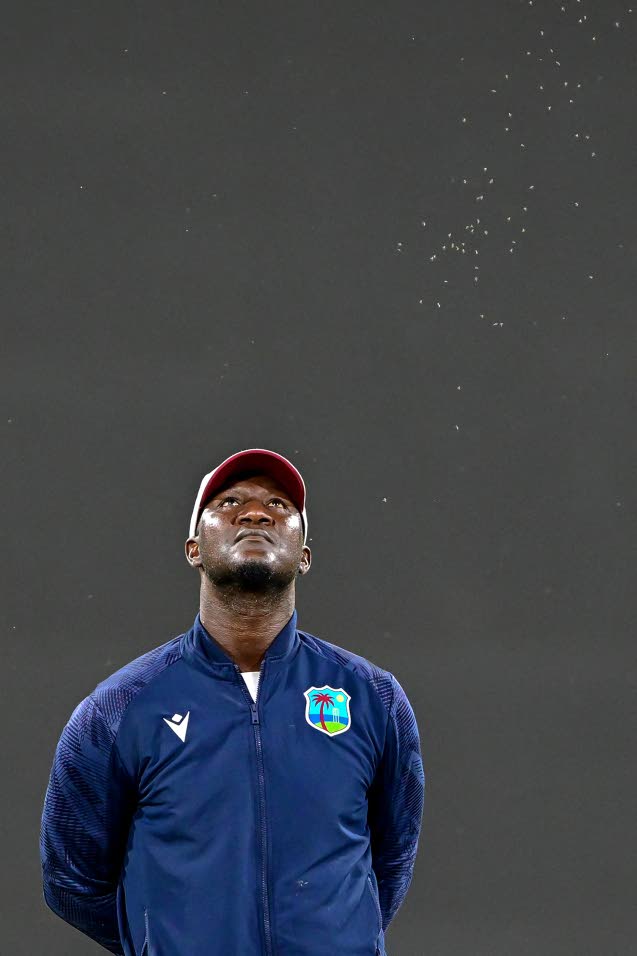
PORT OF SPAIN, Trinidad — The future of Daren Sammy as head coach across all cricket formats for the West Indies team may be decided by their performance in the imminent T20 World Cup, according to prominent cricket analyst Ian Bishop.
Since assuming the role of all-format head coach on April 1, Sammy—who previously led the West Indies to two T20 World Cup championships as captain—has faced a challenging initiation. His tenure has witnessed mixed outcomes, with notable successes including a historic 2-1 One Day International (ODI) series win against Pakistan in August and a comprehensive 3-0 T20 International (T20I) series sweep over Bangladesh in October.
Conversely, the team has encountered significant setbacks under his leadership, suffering Test and T20I defeats to Australia, a Test series loss to India, an ODI series defeat against Bangladesh, and a recent clean sweep by New Zealand across T20I, ODI, and Test formats.
With the next T20 World Cup scheduled for February to March 2026 in Sri Lanka and India, Bishop suggests that Sammy’s continued leadership may be contingent upon the team’s performance in this premier tournament. During a recent interview on iSports i95.5 FM, Bishop acknowledged that Sammy’s current track record presents concerning reading.
“The results thus far do not present a favorable reflection for Daren Sammy,” Bishop stated. “He began with three exceptionally challenging series—though he was aware of this upon accepting the position—facing Australia in the Caribbean, India in India, and New Zealand in New Zealand, where we haven’t secured a Test victory since 1995. That represents three decades without a Test win in New Zealand, which undoubtedly brings disappointment, particularly from a Test cricket perspective.”
Bishop emphasized that the true evaluation of Sammy’s coaching capabilities will emerge through the white-ball format: “The genuine benchmark will be the T20 World Cup next year. This is a squad with substantial potential from a batting standpoint, if perhaps less so in bowling. The critical question becomes: what criteria will we use to assess him? I believe his future will heavily depend on the white-ball performance demonstrated during the upcoming two months.”