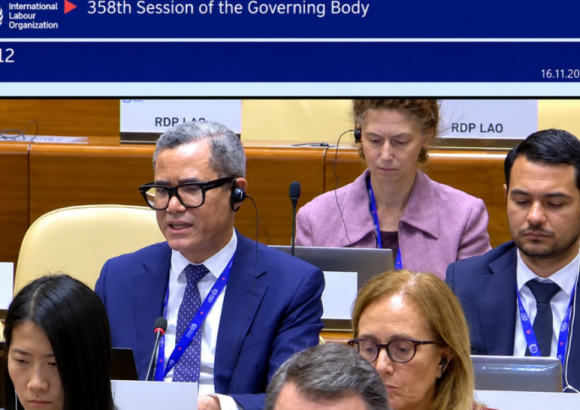
In a high-profile address delivered at the 358th session of the International Labour Organization’s (ILO) Governing Body in Geneva, Switzerland, Dominican Republic Minister of Labor Eddy Olivares Ortega publicly reaffirmed his nation’s unwavering dedication to delivering on all priority objectives laid out in the landmark Punta Cana Declaration. During panel deliberations focused on rolling out a coordinated regional implementation framework for the declaration, Minister Olivares emphasized that the core collective task for signatory nations across the Americas is to translate the broad consensus forged at the 20th ILO American Regional Meeting into tangible, quantifiable outcomes that directly uplift livelihoods for working populations.
Olivares laid out a detailed roadmap of targeted priorities the Dominican Republic is prioritizing to advance this agenda: bolstering national labor administration infrastructure and inspection capacities to enforce existing workplace rules, scaling up formal employment pathways to reduce informal labor’s disproportionate share of the workforce, supporting the long-term viability of small and medium-sized sustainable enterprises, broadening the scope of national social protection and public care service systems, establishing clear regulatory guardrails for the fast-growing digital platform economy, institutionalizing universal occupational safety and health standards across all industries, and accelerating efforts to fully eradicate all forms of child labor. He additionally pledged national support for expanded skills training and inclusive employment pipelines for young people, systematic progress toward closing gender gaps in the world of work, and strict safeguards to eliminate all forms of workplace violence and harassment.
The Dominican labor minister voiced full endorsement of the implementation plan drafted by the ILO Regional Office for Latin America and the Caribbean, while noting that no one-size-fits-all framework will work for the diverse nations across the region. He stressed that every participating country must adapt the plan to align with its unique local socioeconomic context and existing institutional operational capacity. To ensure steady, accountable progress, Olivares called for the framework to be anchored in clearly defined actionable targets, contextually relevant performance tracking indicators, full, meaningful engagement from national employers’ associations and workers’ trade unions, and scheduled periodic progress reviews to identify emerging bottlenecks and adjust strategies in real time.
Olivares also reminded fellow Governing Body delegates that the Dominican Republic had the distinct honor of hosting the first in-person ILO regional meeting held globally after the COVID-19 pandemic, which convened in Punta Cana from October 1 to 3, 2025. He framed the Punta Cana Declaration not as a static symbolic document, but as a dynamic, enduring collective promise to expand equitable opportunities, uphold enforceable labor rights, and guarantee basic human dignity for every working person across the Americas.
On the sidelines of the declaration deliberations, Minister Olivares represented the Dominican Republic as a full voting member of the Governing Body’s Central American and Dominican Republic constituency during the secret-ballot election for the next ILO Director-General. Togolese incumbent Gilbert F. Houngbo was successfully re-elected to serve a second five-year term running from October 1, 2027, through September 30, 2032. Olivares noted that the Dominican Republic’s status as one of just five elected government seats allocated to the Americas on the 56-member Governing Body — alongside permanent non-elected seats held by the United States and Brazil — reflects the growing international credibility and diplomatic standing the nation has built within the UN-affiliated labor governance body. The ILO Governing Body’s 56 total seats are split evenly across 28 government representatives, 14 employer delegates, and 14 worker representatives, each holding an equal single vote for leadership elections.