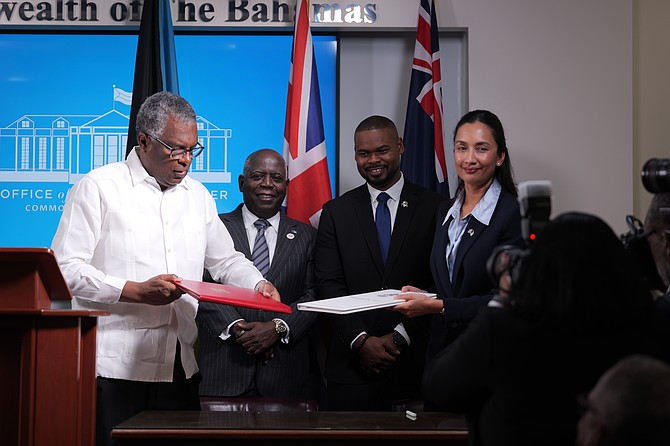
After more than three decades of on-again, off-again diplomatic deliberations, The Bahamas and the Turks and Caicos Islands formally signed a landmark maritime boundary agreement this week, putting a definitive, legally recognized demarcation line between their adjacent offshore waters for the first time in modern history. The signing ceremony, hosted at the Office of the Prime Minister of The Bahamas, saw representatives from The Bahamas put their names to the document alongside British officials, who act as the legal diplomatic representative for the Turks and Caicos Islands, a British Overseas Territory.
Formal negotiations over the shared maritime border first launched in 1992, with technical teams from both sides reaching a preliminary consensus on the line’s coordinates as early as 1996. That draft technical accord was never formally ratified, however, leaving the critical jurisdictional question hanging unresolved for 28 additional years. The long-dormant dialogue was reactivated in August 2023 during working group meetings in New Providence, followed by a second round of high-stakes negotiations in Providenciales in September 2024 that locked in the final terms of the treaty.
The newly formalized boundary, drafted in full alignment with the frameworks laid out in the United Nations Convention on the Law of the Sea, establishes unambiguous jurisdictional limits that define where each nation’s sovereign rights over fishing, law enforcement, resource management and maritime surveillance begin and end. Prior to this accord, no formal mutually agreed line existed, creating ambiguity for local fishing crews, coast guard patrol teams and marine regulators operating in the overlapping adjacent waters.
In remarks delivered during the signing ceremony, Bahamian Prime Minister Philip Davis hailed the outcome as a testament to the persistent, good-faith efforts of generations of diplomatic and technical staff who refused to let the negotiations stall permanently. He emphasized that the treaty will eliminate longstanding confusion for small-scale commercial and artisanal fishermen who previously risked accidental cross-border incursions, streamline cross-jurisdictional law enforcement operations, and create a formal foundation for joint conservation work to protect the region’s ecologically sensitive shared coral reef systems and shallow fishing banks.
Bahamian Minister of Foreign Affairs Fred Mitchell framed the agreement as a landmark diplomatic win, noting that The Bahamas had maintained a consistent, good-faith negotiating position advocating for an equidistant split of the overlapping shared waters from the time talks resumed in 2023. Turks and Caicos Deputy Premier Jamell Rayan Robinson went on to note that the accord carries significance far beyond a simple jurisdictional line, calling it a defining milestone in the two territories’ centuries-long intertwined shared history – which includes a period of joint colonial administration before the Turks and Caicos was established as a separate British colony. Robinson outlined that the next phase of implementation will involve updating all official nautical charts and operational maritime databases to reflect the new boundary, delivering targeted training and coordination guidance for maritime patrol personnel, and rolling out public outreach campaigns to share clear, accessible rules with all local fishermen and commercial boat operators.
British High Commissioner to The Bahamas Smita Rossetti reaffirmed the United Kingdom’s longstanding commitment to upholding the UN Convention on the Law of the Sea as the universal legal framework for global ocean governance, noting that such clearly defined maritime borders deliver tangible, long-term safety and economic benefits for coastal communities on all sides.
The newly ratified treaty marks only the second formal settled maritime boundary The Bahamas has finalized to date, following a 2011 accord with Cuba that entered into force in 2012. Negotiations to formalize a maritime border between The Bahamas and the United States remain ongoing. The two neighboring Caribbean jurisdictions already have a robust track record of collaborative maritime action, including a 2021 shiprider agreement that enables integrated cross-border operations between the Royal Bahamas Defence Force and Turks and Caicos maritime security agencies, with a core initial focus on disrupting irregular migration routes in the shared regional waters.