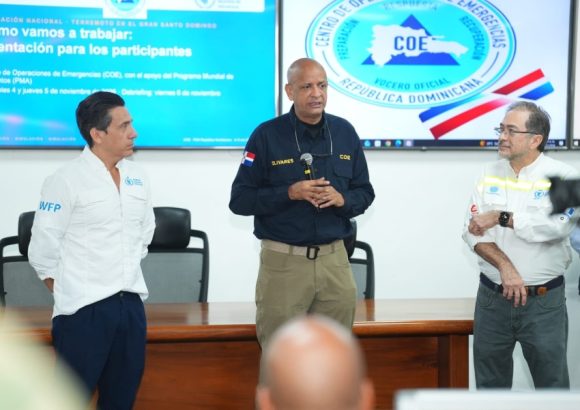
Santo Domingo, Dominican Republic – In a landmark drill designed to shore up national disaster resilience, the country’s Emergency Operations Center (COE) has completed a full-scale simulation of a high-magnitude earthquake striking the Greater Santo Domingo metropolitan area, with targeted technical backing from the United Nations World Food Programme (WFP).
The coordinated exercise brought every agency under the Dominican National Response System together to rigorously test every step laid out in the official National Earthquake Contingency Plan: from initial emergency activation protocols, cross-agency coordination workflows, and real-time inter-departmental communication, to rapid resource mobilization, public-facing information dissemination, and agile collective decision-making in the context of a large, chaotic complex disaster.
Speaking at the closing of the drill, COE director Colonel Erdwin Olivares Luciano emphasized that successful, life-saving disaster response is not built in the middle of a crisis, but through consistent pre-event planning, hands-on training, and sustained alignment across all public and civil response institutions long before any emergency unfolds.
Beyond validating existing response workflows, the simulation was structured to systematically map out both core operational strengths and unaddressed gaps across the national response network, giving officials clear, actionable data on how well disparate agencies can collaborate under the extreme pressure of a major catastrophic event.
Alex Robayo, WFP’s representative in the Dominican Republic, noted that these kinds of immersive, high-stakes simulation exercises are irreplaceable for meaningful preparedness, as they give authorities a low-risk environment to audit their on-the-ground capabilities, refine outdated protocols, and iron out coordination bottlenecks that would otherwise become deadly flaws during a real earthquake.
The entire initiative received full technical guidance from WFP, while funding was provided by the United States Government via the Resilient Basin project, a regional program focused on elevating community disaster preparedness and minimizing the disproportionate harm that natural disasters inflict on low-income and vulnerable population groups across the Caribbean basin.
COE officials confirmed that all data, feedback, and lessons captured during the simulation will be formally integrated into national emergency frameworks: teams will revise and upgrade existing response protocols, streamline cross-agency coordination mechanisms, and roll out targeted follow-up training to lift the overall operational readiness of every institution tasked with protecting Dominican communities during crises.
COE strengthens coordination ahead of potential major earthquake