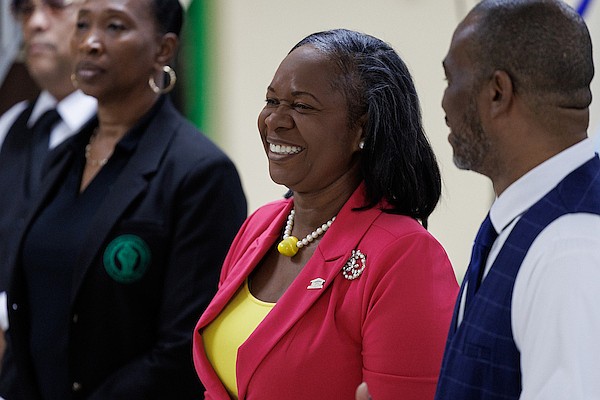
In a poignant full-circle moment, Bahamas Union of Teachers (BUT) president Belinda Wilson put pen to paper on her final collective bargaining agreement yesterday, in the very same conference room where she helped hammer out the union’s first official industrial contract two decades prior. The milestone signing caps more than 12 months of tense negotiations that at one point pushed the nation’s educators to the edge of coordinated industrial action, as members had rejected the government’s sixth financial counteroffer just weeks earlier, voting overwhelmingly to authorize job action and placing over 1,400 educators on formal industrial action alert ahead of the new academic year.
The five-year contract, active retroactively from July 1, 2025 through to 2030, delivers sweeping long-awaited improvements for the country’s teaching workforce: it lifts the maximum annual teacher salary to $54,000, and raises entry-level starting pay to $30,100, alongside formalized expanded paternity and maternity leave provisions. The Ministry of Education, Science and Technology has also committed to launch a targeted breastfeeding support pilot programme, a measure Wilson emphasized is particularly critical given that 85% of BUT’s membership are women.
Additional layered benefits included in the deal are rental disturbance stipends, hardship allowances, special education premium pay, and remote geographical posting support, plus a structured retention bonus calculated as a percentage of a fully trained teacher’s maximum annual salary. Educators will also receive one-off lump sum payments of $700 in the contract’s third year, and $750 in the fifth year, with a clause allowing both parties to reopen negotiations no later than the three-year mark to address unforeseen emerging needs.
Wilson, who has announced she will not seek re-election ahead of her scheduled July 5, 2028 retirement – meaning she will step down before the 2030 contract expiry – noted that the new compensation structure is explicitly designed to stem widespread teacher attrition. She acknowledged that while educators remain deeply dedicated to their students and their craft, they have long faced unsustainable financial pressures that force many to leave the profession to cover basic living expenses.
She also confirmed that her union leadership team has completed specialized professional negotiation skills training to prepare for a seamless transition after her departure, and urged her successors to uphold the highest standards of public service. “You carry the privilege and honour of representing thousands of teachers across every island from Grand Bahama to Inagua,” she told her team during the signing ceremony. “The membership placed their trust in you, so you must never take that responsibility lightly: this role is about service, service above self.”
Permanent Secretary of the Ministry of Education Neil Campbell, who was joined at the event by ministry leadership and union executive members, reaffirmed the government’s full commitment to supporting Bahamian educators. Noting that both he and Deputy Prime Minister and Education Minister Chester Cooper are former career teachers, Campbell said the negotiation process never lost sight of the on-the-ground realities facing school staff. “Too often, parties on opposite sides of bargaining tables disconnect from their roots and the shared goals that bring them to the table,” he said. “That never happened here: Minister Cooper was fully invested in delivering on every promise we made to our teaching community.”
The breakthrough that unlocked the final deal came days after the union issued its industrial action alert, when Wilson and BUT delegates met directly with Prime Minister Philip “Brave” Davis, Minister Cooper, and senior representatives from the Ministry of Finance and Ministry of Public Service at the Office of the Prime Minister to resolve all remaining outstanding financial sticking points. Following that mediated meeting, Wilson said the entire BUT membership was “elated” at the prospect of a fair, finalized agreement that addresses years of unmet needs for the profession.
Teachers’ pay dispute ends with new industrial agreement