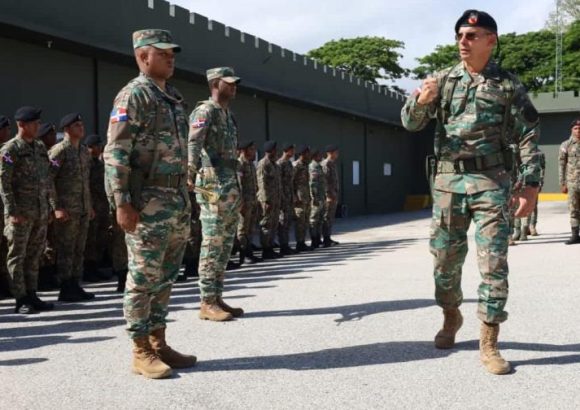
Santo Domingo, Dominican Republic – In response to spiraling security chaos across its shared 300-kilometer frontier with Haiti, the Dominican government has mobilized over 10,000 active-duty military personnel to secure the entire border stretch, senior administration officials confirmed in recent public announcements. Local Dominican media outlets first documented the arrival of military reinforcement convoys in southern border communities over the weekend: Diario Libre released verified footage showing at least seven Dominican Army vehicles entering the Jimaní border municipality, while Telemicro captured a separate deployment of roughly 40 service members arriving via tanks and heavy military trucks to occupy a local fortified military installation. The troop buildup was formally confirmed by Minister of the Presidency José Ignacio Paliza during a Thursday press briefing, where he laid out a long-term border security roadmap that includes the construction of nearly 80 kilometers of fortified border barrier infrastructure, outfitted with advanced surveillance and defensive systems, slated for full completion by the end of 2027. Paliza emphasized that the Dominican government would allocate all necessary additional resources, personnel, and equipment in the coming days, weeks, and months to safeguard national territorial integrity, noting that no major security breaches or threats to Dominican state sovereignty have been recorded since the latest surge of violence began in neighboring Haiti. The heightened security posture on the Dominican side comes as Haiti grapples with an unprecedented breakdown of public order, fueled by the rapid expansion of heavily armed criminal gangs that now control large swathes of the capital Port-au-Prince and surrounding rural areas. Tensions spiked regionally last Sunday after four Salvadoran soldiers assigned to the UN-authorized Gang Suppression Force (GSF) were ambushed and went missing on the outskirts of Port-au-Prince. A fresh contingent of Salvadoran troops arrived in the Haitian capital on Thursday to join intensive search operations for the missing service members, with Salvadoran President Nayib Bukele publicly denouncing Haitian gangs as “satanic” on Friday and vowing that the international security mission would prevail in its efforts to locate the missing personnel and push back gang control. The GSF, which currently has 1,000 deployed troops out of a planned total 5,500, was first greenlit by the United Nations Security Council one year ago to counter gang violence and stabilize Haiti, with the council voting to extend its operational mandate for an additional six months on September 29. According to latest UN-tracked data, more than 5,700 Haitian civilians have been killed or wounded in gang-related attacks so far this year alone, with armed groups also responsible for over 230 reported kidnappings and the documented sexual assault of more than 1,000 women and girls across the country. The cascading instability has thrown long-planned Haitian presidential and legislative elections, already delayed repeatedly over recent years, into complete disarray: the Provisional Electoral Council (CEP) recently announced it would push back the official start of election campaigning and release a revised electoral calendar, but no new timeline for the December 13 originally scheduled vote has been publicly released to date.
Dominican Republic sends troops to border amid rising tensions in Haiti