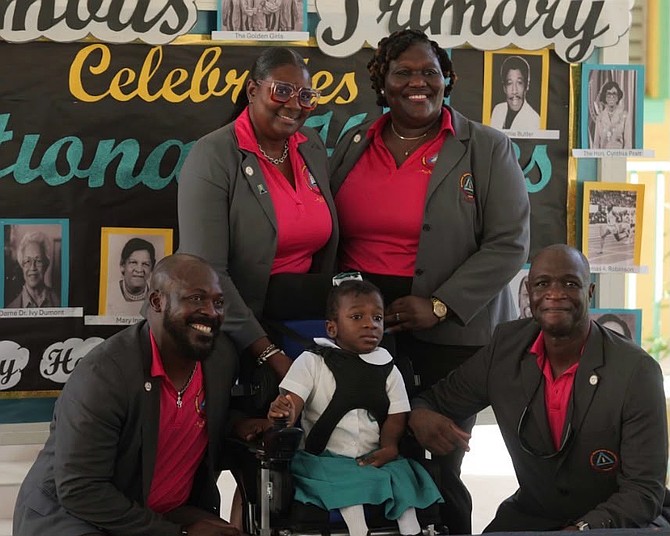
For years, Anna Thompson has shouldered the daily routine of physically lifting her 10-year-old daughter to and from classes, and supporting her through every movement across school grounds. That routine changed forever on a memorable school assembly day, when a long-held wish for independence became a reality for Naveah Strachan, a Columbus Primary School student born with osteogenesis imperfecta — more commonly known as brittle bone disease, a genetic condition that leaves bones extremely fragile and prevents Naveah from walking on her own. On that day, Naveah navigated her new motorized wheelchair independently for the first time, bringing both mother and daughter to tears of overwhelming joy.
As Naveah guided the chair alongside her mother, her feet resting easily on the device’s built-in pedals, both mother and daughter struggled to hold back happy tears. Ms. Thompson gently wiped the tears streaming down her daughter’s face, as the young student took in the milestone of moving through space on her own power for the first time in her life.
Naveah has dreamed of independent mobility for as long as her mother can remember. When Naveah was born, doctors confirmed she would never be able to walk, a reality that did not dim the young girl’s hope. “As she grew older, she would always say, ‘Lord, I wish one day I could walk,’” Ms. Thompson shared. “I always encouraged her that God would let her walk one day. I never minded lifting her every day; I never took our time together for granted. She’s my miracle baby.”
Osteogenesis imperfecta refers to a group of genetic conditions that cause excessive bone fragility, leading to frequent fractures that can occur with little to no obvious trauma. For Naveah’s entire schooling career, the daily trip to and from campus fell entirely to Ms. Thompson, who carried her daughter every morning and afternoon. During school hours, teachers had to manually push Naveah in a basic manual wheelchair to get between classes and activities — a barrier that left many school events, including annual Sports Day, out of reach for the young student.
That barrier was removed this week, when the Bahamas Educators Managerial Union (BEMU) donated the custom motorized wheelchair to Naveah during a school-wide assembly. The union’s leadership said the donation was intended to remove daily mobility barriers and make Naveah’s entire learning experience more accessible and comfortable.
BEMU President Stephen McPhee said the motorized chair will not only simplify Naveah’s daily commute home after school, it will also open the door to her joining activities she has never been able to participate in before, including the school’s upcoming Sports Day. McPhee himself became emotional as he spoke about Naveah’s story, tearing up as he recalled first learning about her daily struggle and the assistance she needed to navigate campus independently.
As Naveah tested out her new wheelchair, her classmates erupted in cheers, and the 10-year-old waved back to her supportive peer group while her mother held her close.
Gregory Cash, a guidance counsellor at Columbus Primary who also relies on a motorized wheelchair for daily mobility, said he felt extraordinary joy watching Naveah receive the device that has transformed his own life. With characteristic warmth, he even joked, “One day I hope we can have a racing competition together.” Beyond the celebration of Naveah’s milestone, Cash used the moment to emphasize a critical, broader point: the urgent need for greater inclusion in national education systems. He stressed that all people with disabilities deserve equal access to opportunities, and the support to pursue their dreams no matter what field they choose to enter.