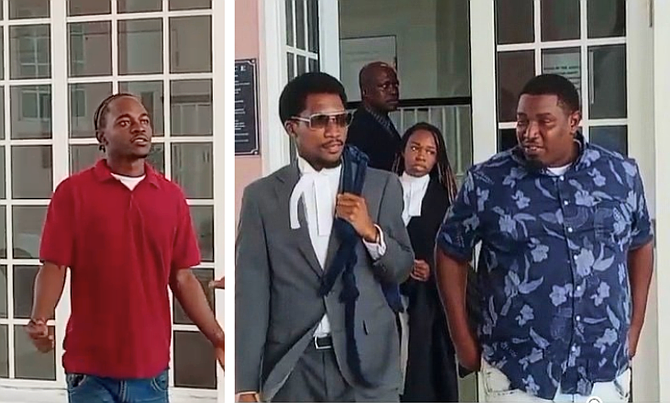
After six years of lingering legal uncertainty hanging over their lives, two Bahamian men walked free from the Supreme Court in Grand Bahama on Wednesday, after an eight-member jury delivered not guilty verdicts on charges of a high-profile 2020 double murder. Trevor Reckley Jr. and 23-year-old Shamaz Brown, who was just 15 when he was first charged, were cleared of murdering Kim Smith and Denny Rolle – two men gunned down in a broad-daylight public shooting on Freeport’s Limewood Lane on May 11, 2020. The jury returned its 6-2 not guilty decision after closed-door deliberations, concluding a weeks-long trial that exposed serious allegations of coercive police misconduct during the investigation.
Prosecutors from the Office of the Attorney General had argued that Reckley acted as the getaway driver, providing a firearm and driving Brown and a third accused suspect, Dillon Williams, to the attack site in a dark Honda Accord just after 3 p.m. According to the Crown’s narrative, Denny Rolle was standing on the street near a parked blue Ford Focus when gunfire erupted from the sedan. Rolle was struck multiple times and succumbed to his wounds later in hospital, while Kim Smith, who was inside the vehicle at the time, died at the scene of the attack.
The prosecution’s case relied heavily on two key pieces of testimony: a claimed confession from Brown, and witness testimony from Williams, who told investigators he saw Brown open fire on the two victims. But both defendants forcefully denied any involvement in the killings from the beginning of the trial, and Brown made explosive allegations of abuse by police while in custody. He told the court that after he was taken into custody as a minor, officers at the Criminal Detective Unit repeatedly slapped him, punched him in the abdomen, and placed a plastic bag over his head to coerce him into confessing to a crime he said he had no part in. Reckley similarly rejected all prosecution claims, denying he drove the co-accused to the scene, provided a weapon, or encouraged the attack.
Following the delivery of the verdict, Justice Andrew Forbes formally discharged both men, thanked the jury for their service, and confirmed the pair were free to leave custody. Speaking to reporters outside the courthouse, both men described the acquittal as a massive weight lifted after half a decade of disruption to their lives.
Brown, who just turned 23, noted the case had hung over him from the middle of his teenage years, blocking him from building a stable adult life. “I feel amazing just to know I get off something that I had nothing to do with,” he told reporters. “I just thank God. He brought me from far, He stayed with me from the start. This is a new beginning for me.” Brown acknowledged he has a separate, unrelated legal matter pending, but emphasized it was nothing compared to the gravity of the double murder charges he just cleared. He also repeated his allegations of police coercion after the verdict, saying “That’s a normal thing they do – they beat you when they can’t get you to confess. They will try to beat it out of you, to make you lie on yourself.”
Reckley echoed that sense of relief, while also outlining the personal and professional damage the six-year case caused. “I feel I would have gone further if I didn’t have this obstacle in my way,” he said. “I lost my job and everything, and now I could finally go back to my life and tell people what happened. This is one of the sweetest things you could ever experience.” Reckley also extended sympathy to the families of the two victims, while reaffirming his innocence: “I really feel sorry for the victims’ family, but I am an honest man. I didn’t know nothing of the crimes.” He thanked his family for standing by him throughout the long legal process.
Defense attorneys celebrated the verdict, while also calling for systemic changes to Bahamian policing practices to root out coercive interrogation tactics. Ryszard Humes, Reckley’s lawyer, said the defense team had identified critical gaps and weaknesses in the prosecution’s evidence from the start. “We’re happy with the verdict today,” Humes said. “We had significant concerns about gaps in the evidence led by the prosecution, and my client consistently denied any involvement. We believe the jury reached the correct decision.”
Krystal Newman, Brown’s defense counsel, raised broader concerns about repeated allegations of improper police conduct in criminal investigations across the country. She noted that defense attorneys regularly encounter clients who claim they were pressured into making false confessions or statements, and argued that this coercive practice should not be accepted as standard procedure. “Such conduct should not be accepted as routine policing, and we need further training to ensure all officers follow proper investigative procedures,” Newman said. “You cannot build a case on things that are not true, and you cannot gather a confession through those sorts of violent means.”
The case marks the end of a six-year legal saga that began when Reckley and the then-minor Brown were charged within days of the 2020 shooting. Sean Smith represented the Attorney General’s Office throughout the trial proceedings.