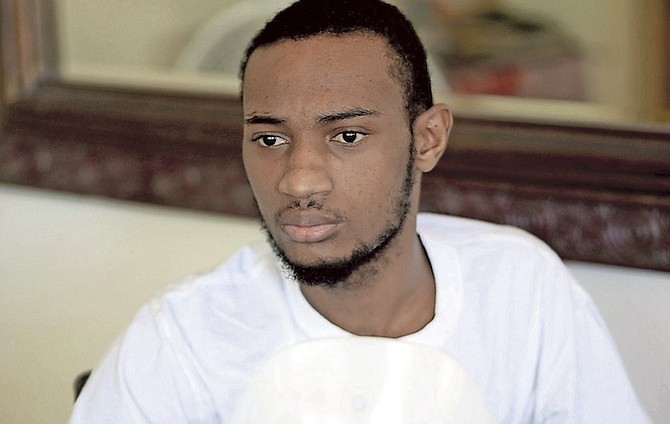
Almost a decade after a police bullet left a 22-year-old Bahamian man permanently paralyzed, a court has issued one of the largest civil damages awards in the nation’s history, ordering the state to pay him just over $941,000 for the life-altering harm he sustained.
The case centers on Thorne Clarke, whose life was irrevocably changed during a late-night encounter with law enforcement near Nassau’s Wilson Tract on February 13, 2016. What prompted the officer’s use of deadly force remains contested to this day. Police authorities claim officers were searching for a suspect when they spotted Clarke entering his mother’s van, surrounded the vehicle, and opened fire after he allegedly refused to exit and attempted to drive away, putting an officer at risk of being struck. Clarke’s account, by contrast, states he complied with an order to stop, asked for an explanation for the stop that was never provided, and only began to drive off before he was hit by gunfire. One bullet penetrated the van’s rear, struck Clarke in the upper back, and completely severed his spinal cord. He lost control of the vehicle, which crashed into a nearby wall, and never regained the use of his lower body.
The conflicting narratives never went before a civil jury to be resolved. Clarke filed his civil claim against the Commissioner of Police and the Attorney General in 2018, and a default judgment was entered against the state two years later after defendants failed to submit a formal defense. The recent September 21 ruling by Assistant Registrar Jonathan Deal only addressed the final calculation of damages owed to Clarke.
Before the shooting, Clarke was a promising young student: he had graduated from St Augustine’s College, earned a four-year scholarship to the University of The Bahamas, and worked part-time at a local tile factory. An active athlete who played basketball and exercised regularly, he was fully independent. Today, he lives with complete permanent paralysis from the T7-T8 spinal level down, with no control over bladder or bowel function, no sensation or movement in his lower body, and requires full-time mobility assistance via a wheelchair. He has also been diagnosed with post-traumatic stress disorder and secondary major depressive disorder, and experiences recurring painful bedsores that continue to disrupt his daily life.
Clarke was unemployed for seven and a half years after the injury, unable to return to his previous position. He only secured full-time non-permanent work with the National Commission for Persons with Disabilities in mid-2024, earning $1,500 per month, but his ongoing medical issues often force him to leave work early, and the court found he faces a high risk of losing his current position due to his disability.
To accommodate his lifelong care needs, the damages award breaks down into multiple categories: $425,000 for pain, suffering and loss of life amenities, $135,000 for lost future earning capacity, $126,546 for projected lifelong medical supplies and mental health care, $96,264.50 for past lost wages, $60,000 to compensate for five years of full-time unpaid care provided by Clarke’s mother (who closed her own daycare business to care for him), $15,000 in aggravated damages, and $50,000 in exemplary damages. The award also covers past out-of-pocket medical costs and incontinence supplies Clarke has already purchased. An interim $80,000 payment has already been disbursed, leaving roughly $861,893 outstanding before interest and legal costs are added.
In his ruling, Assistant Registrar Deal noted that the $941,893.91 award fell well below the $2.06 million Clarke originally sought, but far exceeded the roughly $539,000 proposed by the state. The $15,000 aggravated damages were awarded in recognition of the profound indignity Clarke suffered: he was handcuffed to his hospital bed for two days immediately after the shooting, as he processed the news he would never walk again. The court also cited the state’s failure to follow through on a promise to release an internal investigation into the shooting, and its refusal to provide any assistance to Clarke in the years after the incident. The $50,000 exemplary damages was explicitly intended to punish the state’s misconduct, deter future excessive use of force, and formally register the court’s disapproval of the officers’ actions. Deal referenced several landmark Bahamian cases of unlawful state conduct in shaping the final award, including high-profile cases of false imprisonment and abusive detention.
The ruling closes the latest chapter in a nearly nine-year legal fight for Clarke, marking one of the largest damages awards ever granted against the Bahamian government in a police shooting case.