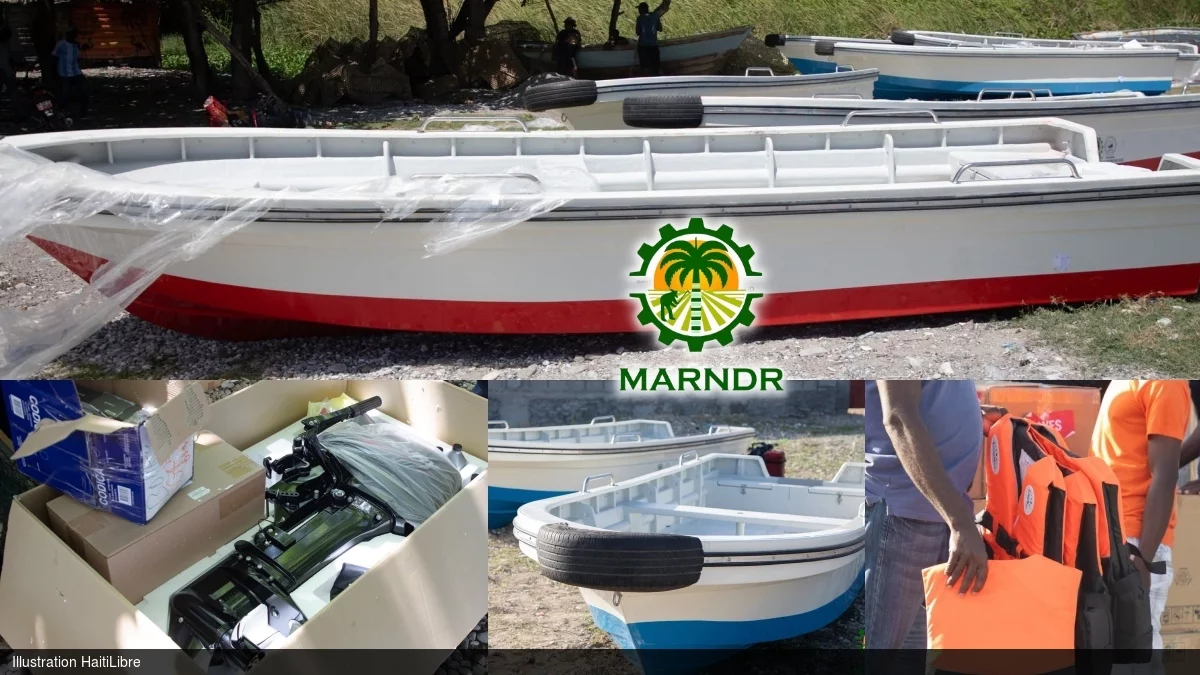
On September 25, Haitian authorities launched a new round of critical equipment distribution for small-scale fishing organizations across the country’s South department, marking the second major rollout of fishing infrastructure support in recent months following a similar initiative in the Grand’Anse region.
The distribution effort was led by Haiti’s Ministry of Agriculture (MARNDR) through its Program to Support Agricultural and Fisheries Productivity and Improve Rural Market Access Infrastructure (PAPAIR), a development initiative backed primarily by funding from the Inter-American Development Bank (IDB). Fisher associations from seven coastal communes—Chardonnières, Les Anglais, Tiburon, Saint-Louis-du-Sud, Aquin, Les Cayes, and Saint-Jean-du-Sud—were selected as beneficiaries for this round of support.
In total, the distribution included 14 purpose-built fiberglass fishing vessels, 40 15-horsepower outboard motors, 7 solar-powered cold storage freezers, 40 engine repair toolkits, 80 complete fishing gear sets, and nearly 200 personal flotation devices. The handover ceremony was presided over by Haiti’s Minister of Agriculture, agronomist Marcelin Aubourg, in a public event highlighting the government’s commitment to growing the blue economy.
Beyond the physical equipment, the IDB-funded PAPAIR program has also paired the distribution with targeted training for participating fisher associations. Laurent Merisier, lead agronomist and central coordinator of the national fisheries project, explained that training modules cover practical high-priority skills including assembly and deployment of fish aggregating devices (FADs), open water navigation, modern sustainable fishing techniques, and long-term equipment maintenance and management.
Minister Aubourg emphasized that the updated tools are designed to transform working conditions for Haitian fishers, enabling them to expand operations, boost overall catch volumes, and capitalize on growing demand for seafood within and outside of Haiti. He noted that the fisheries sector carries untapped economic potential that goes far beyond its historical role as a subsistence activity for coastal communities. The improved income prospects offered by a modernized fisheries sector, Aubourg argued, are already drawing new workers into the industry—including people leaving other struggling sectors to pursue more stable economic opportunities in fishing.
Beneficiaries have expressed widespread satisfaction with the new equipment, which addresses longstanding gaps in the infrastructure available to small-scale fisher associations across the South department. However, program officials from PAPAIR and the Departmental Directorate of Agriculture (DDAS) have stressed that the distribution comes with a clear responsibility for recipient groups to maintain and protect the assets, which represent a major public investment in the region’s long-term economic development. Officials urged beneficiaries to use the equipment transparently and responsibly, with the goal that it will serve entire coastal communities and act as a catalyst for inclusive economic growth across the South department.