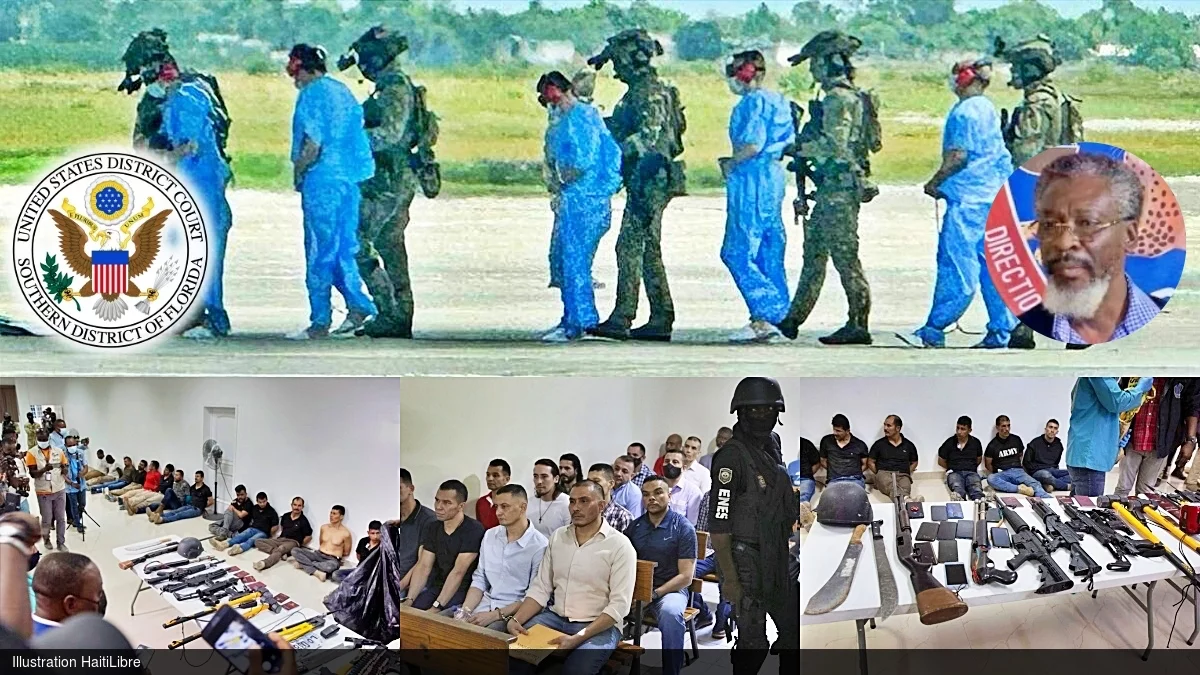
Five years after the 2021 assassination of former Haitian President Jovenel Moïse, a landmark development in the long-stalled legal process has unfolded: 18 key suspects, including one of the alleged plot’s top masterminds and 17 former Colombian mercenaries, have been extradited from Haiti to the United States to face prosecution.
Moïse was killed in a commando-style raid on his private Port-au-Prince residence in the early hours of July 7, 2021, an attack that sent shockwaves through Haiti and left the country facing a years-long political and security crisis. While U.S. law enforcement has made consistent progress in investigating the plot, securing arrests, and securing convictions against co-conspirators, Haitian judicial proceedings have faced crippling delays and institutional hurdles. Half a decade after the assassination, not a single suspect had gone to trial in Haitian courts, leaving demands for accountability unmet.
To break this impasse and advance the pursuit of justice, the Haitian government authorized the extradition of the 18 suspects at the formal request of U.S. judicial authorities, acting under bilateral judicial cooperation agreements between the two nations. Among those transferred is Joseph Félix Badio, a former high-ranking official with Haiti’s Anti-Corruption Unit, who investigators have long identified as one of the central operational architects of the assassination plot on Haitian soil. The other 17 individuals are former Colombian soldiers who allegedly made up the on-the-ground commando team that carried out the assault on Moïse’s residence.
All 18 suspects had been held in Haitian custody since shortly after the 2021 attack. On the morning of Sunday, September 20, 2026, they were loaded onto a U.S. military plane at Port-au-Prince International Airport – all clad in blue jumpsuits, per U.S. official accounts – and flown to the United States. The plane landed shortly before 11 a.m. local time, marking the completion of the long-planned transfer.
Jason A. Reding Quiñones, U.S. Attorney for the Southern District of Florida, confirmed the extradition in an official post on his social media account. The 18 suspects will be tried at the U.S. District Court for the Southern District of Florida, where investigators have already established that much of the plot was planned and funded. To date, 30 people have been formally charged in connection with the assassination in U.S. courts, and several co-conspirators have already been convicted.
“Today marks the beginning of a crucial new phase in our pursuit of justice for the assassination of President Jovenel Moïse,” Reding Quiñones said in a statement. “Our work does not end with the men who planned and executed this assassination. We will follow the evidence wherever it leads us, to those who financed, facilitated, supported, or committed crimes to make it possible. Five years later, we continue to bring defendants to trial in U.S. courts, and we are not finished.”
The extradition comes just one week before the scheduled September 28, 2026, trial of Christian Emmanuel Sanon, a Florida-based suspect accused of being one of the assassination’s chief financial backers and a figure who sought to replace Moïse as president following the attack. In line with the legal principle of double jeopardy, which bars retrial for the same offense, Haitian judicial authorities have officially terminated all local legal proceedings against the 18 extradited suspects, who are now fully under U.S. judicial jurisdiction.
The full list of extradited suspects is as follows: Joseph Félix Badio; Carlos Giovanni Guerrero Torres; Victor Alberio Pineda Cardona; Juan Carlos Yepes Clavijo; Naiser Franco Castaneda; Angel Mario Yarce Sierra; Jheyner Alberto Carmona Flores; Edwin Enrique Blanquicet Rodriguez; Manuel Antonio Grosso Guarin; Jhon Jairo Ramirez Gomez; Francisco Eladio Uribe Ochoa; Alejandro Giraldo Zapata; Neil Caceres Duran; Jhon Jader Andela; Enalber Vargas Gomez; Jhon Jairo Suarez Alegria; Gersain Mendivelso Jaimes; and Alex Miyer Pena.
Haitian officials emphasized that the extradition agreement preserves the country’s legal prerogatives and interests. Under the terms of the bilateral mutual legal assistance pact, any new evidence uncovered during the U.S. proceedings will be shared with Haitian investigators to support ongoing local investigations into other unindicted co-conspirators. In a statement, the Haitian government said the decision reflects its enduring commitment to leveraging every available avenue of international cooperation to ensure accountability, delivering justice for Moïse, his family, and the Haitian people who have waited five years for closure.