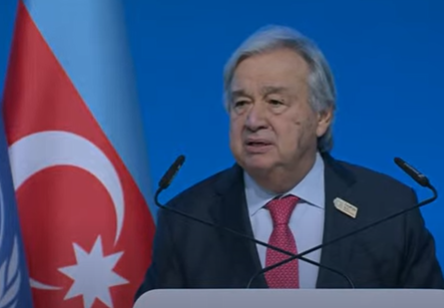
Ahead of the high-level week of the 81st United Nations General Assembly, which will bring global leaders together in downtown Manhattan, United Nations Secretary-General António Guterres has framed the gathering against a backdrop of seismic shifts in global power dynamics and rapidly escalating systemic uncertainty. With Guterres set to step down from his post at the end of 2026, he used a pre-General Assembly press conference at UN Headquarters on September 16 to argue that the changing global landscape demands adaptation from the United Nations, while emphasizing that organizational reform must never come at the cost of core founding principles. Instead, he argued, these values must be defended with renewed conviction. “The United Nations is not just a platform, it is a promise,” Guterres told reporters. “So my message to leaders comes down to this: Keep your promises. Live up to the UN Charter. Be true to the ideals you pledged to uphold. Defend international law. Protect human rights. Invest in sustainable and inclusive development. And push for peace. Now more than ever.”
Calls for sweeping UN institutional reform have gained momentum in recent years, coming from a diverse coalition of stakeholders ranging from vulnerable small island developing states to major powers including the United States. But as leaders prepare to convene, the full attention of the international community remains anchored to the escalating, ongoing conflict roiling the Middle East – a crisis Guterres identified as the most urgent priority ahead of the General Assembly’s debates. “De-escalation must be priority one, priority two and priority three,” he stressed, calling on all warring parties to immediately halt all operations that target or harm civilian populations, and to clear all barriers to unimpeded, safe access for humanitarian aid workers and supply convoys.
Guterres also issued a clear call for international law to be upheld in critical strategic waterways: he demanded that navigational rights and freedoms be fully restored and respected around the Strait of Hormuz and Bab al-Mandab, global chokepoints that carry a large share of the world’s seaborne trade. He reiterated that the only viable path out of escalating regional tension runs through “de-escalation, diplomacy and dialogue.”
Turning specifically to the long-simmering Israeli-Palestinian conflict, the Secretary-General urged the international community to not turn away from the catastrophic humanitarian suffering of Palestinian communities in Gaza and the Israeli-occupied West Bank. He insisted any finalized peace plan for Gaza must be implemented in full, with no restrictions on the entry and distribution of life-saving humanitarian aid. He also called for an immediate end to what he termed the “creeping annexation” of West Bank territory, stressing that a lasting, just peace across the Middle East can never be achieved without the full implementation of a two-state solution.
Guterres also addressed the ongoing full-scale Russian invasion of Ukraine, noting that the conflict is now entering its fifth year, with unthinkable civilian toll and cascading negative impacts on the global economy and food security that extend far beyond Eastern Europe. “It is time for an immediate ceasefire as a first step towards a just, lasting and comprehensive peace – in line with the UN Charter, international law, and relevant UN resolutions,” he said.
Shifting focus to emerging transnational challenges that will dominate General Assembly agenda items next week, Guterres turned to the rapid, unregulated advancement of artificial intelligence, calling for urgent global action to address growing risks associated with the technology. He acknowledged that AI holds unprecedented transformative potential: it can speed progress toward the UN’s sustainable development goals, expand access to quality education, strengthen global public health systems, and boost communities’ ability to adapt to the impacts of climate change. But he also highlighted that even leading AI developers are increasingly sounding the alarm that the technology is advancing far faster than global regulators’ and societies’ understanding of its catastrophic potential risks.
“We cannot afford to ignore concerns that have been raised, especially by those on the frontlines of the development of AI,” Guterres said. He emphasized that national governments bear the primary responsibility for protecting their citizens from AI-related harms, noting that meaningful risk mitigation requires far more than vague good intentions from global policymakers. To address this gap, the United Nations has already established the Independent International Scientific Panel on AI, a global body that brings together leading scientific expertise from across the world to ensure AI governance policy is rooted in robust empirical evidence. Guterres confirmed that AI will be a central topic in his bilateral and multilateral discussions with world leaders during high-level week, and that the UN is actively working to advance practical, actionable policy frameworks for safe AI development in the coming weeks.
Guterres argued that the international community must build a shared global consensus on how to advance the safe, secure, and responsible development of AI, including establishing clear frameworks for when more powerful AI systems require stricter safeguards or additional regulatory intervention to mitigate systemic risks. “This requires genuine international cooperation and a coordinated global effort,” he said, acknowledging deep geopolitical divides around AI governance but warning that these splits must not be allowed to derail urgent work to improve global AI safety.
Climate change, another longstanding core priority for the UN, was also flagged as a key issue for the upcoming General Assembly, with Guterres implicitly tying the need for cross-border cooperation on AI to the larger demand for collective action on slowing global temperature rise and supporting vulnerable developing states.