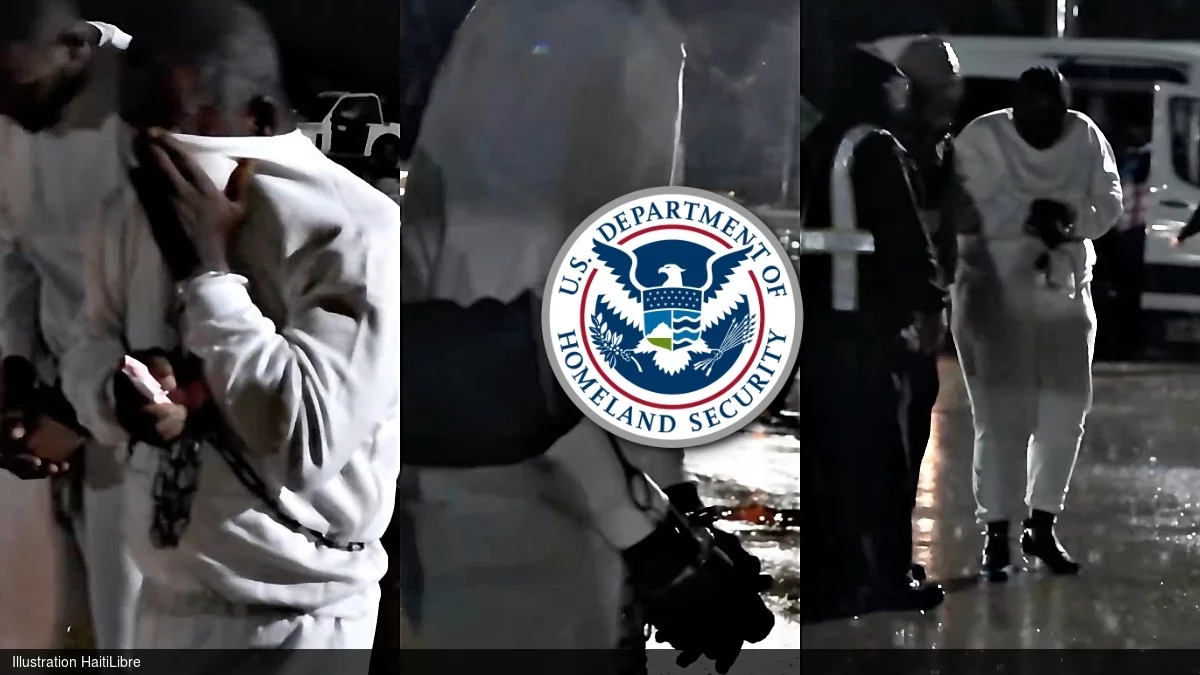
In a newly released footage that has sent shockwaves across the international community, the U.S. Department of Homeland Security has publicly shown Haitian migrants being deported with their wrists and ankles bound, connected by a single chain fastened around their waists as they are escorted up the steps of a deportation aircraft. The official statement accompanying the video left no room for ambiguity: following the termination of Haiti’s Temporary Protected Status (TPS), all migrants with expired TPS authorization are considered to be staying in the U.S. illegally, and they face only two outcomes — voluntary immediate departure or forced deportation.
The dehumanizing treatment of the expelled Haitian migrants has immediately drawn fierce condemnation from human rights groups around the globe. Critics have slammed the U.S. immigration policy for its cruel treatment, labeling the practice a clear example of dehumanization and moral depravity. They emphasize that Haiti is currently grappling with an unprecedented catastrophic security and humanitarian crisis, where armed gangs control large swathes of territory and widespread violence has made daily life untenable for most of the population.
Sending migrants back to this dangerous environment in shackles, critics argue, is not only unjust but also a violation of basic human dignity. Upon arrival in Haiti, many of the deported migrants are immediately met by armed police on airport tarmacs, and their risk of falling victim to violence or even death is extremely high. The international community and migrant rights advocates widely agree that this heavy-handed treatment is disproportionate, degrading, and ignores the desperate circumstances that forced many Haitians to flee their home country in the first place.
Despite the widespread backlash and intense humanitarian controversy, U.S. authorities have defended their use of physical restraints during these deportation operations, citing long-standing security protocols for deportation flights. The Biden administration has laid out two core justifications for the practice. First, the policy aligns with standard flight security protocols enforced by U.S. Immigration and Customs Enforcement (ICE). According to ICE rules, physical restraints are systematically used during the air transfer of deported individuals to prevent any in-flight incidents, resistance from detainees, or attempts to disrupt the operation of charter deportation aircraft.
Second, U.S. officials claim that enhanced coercive measures are justified by the profiles of many of the deported migrants. Authorities note that a portion of the people expelled on these flights have prior criminal records or have completed custodial sentences for offenses committed while in the United States. Beyond security justifications, the deliberate public release of the images of shackled migrants is part of a deliberate deterrence strategy implemented by the current administration to curb unauthorized immigration, sending a public message to potential future migrants that illegal entry will result in harsh consequences.
As the controversy continues to unfold, the international community remains divided over the ethics of the policy, with human rights groups continuing to push for the U.S. to reverse its termination of Haitian TPS and end the degrading treatment of deported migrants.