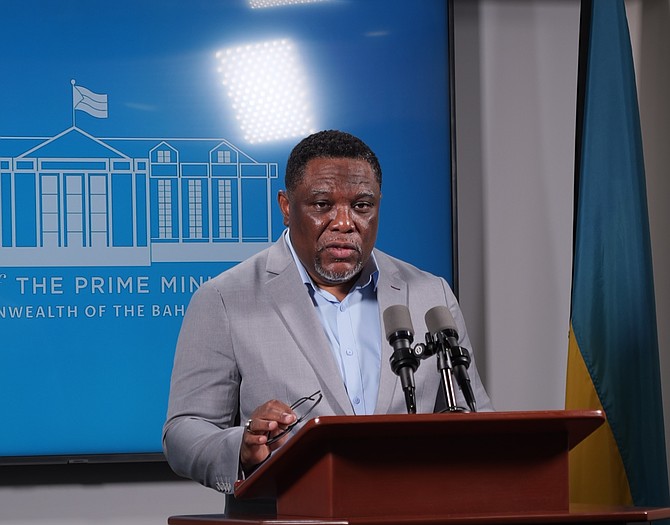
Widespread, prolonged power outages have plagued New Providence for weeks, leaving many residents without electricity for days at a time – and leaders of the Bahamas’ key energy providers say consumers should prepare for continued disruptions through the end of summer, driven by unforeseen record-high temperatures and decades-old infrastructure. Senior energy officials laid out the challenges facing the country’s power grid during a press conference hosted by the Office of the Prime Minister, outlining the multiple overlapping factors that have sparked the recent crisis.
Anthony Christie, chief operating officer of Bahamas Power and Light (BPL), told reporters that the utility cannot promise fewer outages over the coming weeks. After two to three months of above-average temperatures that have already pushed the grid beyond its planned capacity, meteorological forecasts call for even hotter conditions in August and September, which will send demand for air conditioning even higher.
While BPL conducts annual planning for peak summer energy demand, Christie said current temperatures and consumption levels were well outside projections. “Based on abnormal conditions, we’re seeing higher loads, higher temperatures and more frequent failures on equipment,” he explained. “So that’s now straining a lot of our resources that we did not really anticipate would be needed at this level.”
When pressed on whether BPL had failed to adequately prepare for summer demand, Christie rejected that claim, emphasizing the current crisis stems from entirely unforeseen conditions. Utility crews are working around the clock to reinforce grid infrastructure, reduce outage durations and minimize disruption for households, but Christie stressed that 100% uninterrupted power is not a realistic outcome. “They don’t want the light to never go off, but that’s not reality,” he said. “The light will go off. The power will go off. There will be an issue, a challenge that has to be addressed. But again, we’re trying to shorten the outages and lessen the impact.”
BPL Executive Chair Christina Alston echoed that defense of the utility’s preparation work, noting that no mechanical or electrical system delivers flawless, constant operation. “Saying that the system is going to be on 100 percent of the time, that is a very unrealistic goal,” she said. “No system is 100 percent, 100 percent of the time. Your car doesn’t work 100 percent, 100 percent of the time. Nothing mechanical or electrical works 100 percent, 100 percent of the time. But what we have done is systematically gone through and mitigated where we could see problems occurring.”
Alston described the Bahamas’ power network as one of the most complex in the Caribbean, and urged residential consumers to give providers flexibility by cutting back on unnecessary energy use through the remaining hot months. Officials clarified that this call is not asking residents to give up air conditioning or other home comforts – only to use energy mindfully.
Dareo McKenzie, chief executive officer of Bahamas Grid Company (BGC), which now manages New Providence’s transmission and distribution network under the government’s ongoing energy reform agenda, acknowledged public frustration but offered a lighthearted perspective on temporary outages: “Sometimes it may not be a bad thing. I go out and sit on the beach and enjoy what this beautiful island has to offer.” He quickly added that this personal take does not override the provider’s core commitment to consumers: “But to each his own, and it does not override our sacred responsibility to the consumers, which is to provide safe, reliable, and resilient service.”
McKenzie noted that New Providence’s grid faces consistent pressure from two daily peak demand periods, leaving the system almost no time to recover. BPL has already asked government agencies to cut energy consumption by reducing air conditioning use in public buildings, a step Alston said has already helped the provider restore power to more residential users and small businesses.
Alongside ageing infrastructure and abnormal heat, BGC is also grappling with persistent workforce challenges: the company struggles to recruit and retain skilled line workers. Currently, BGC only fields between 60 and 80 line workers to cover demand, though McKenzie said the company has taken steps to address the gap, including recruiting graduates from the Bahamas Technical and Vocational Institute, advertising open roles, and hiring experienced former BPL staff, including retired workers.
The current grid challenges come as the Davis administration prioritizes broad energy sector reform. The government recently transferred responsibility for New Providence’s transmission and distribution network to BGC for long-term upgrading and maintenance, after originally structuring the partnership with Pike Corporation, a US firm whose Bahamian subsidiary Island Grid Solutions was set to be BGC’s majority shareholder – though Pike has since withdrawn from the arrangement.
A correction appended to the original reporting clarifies that McKenzie, not Christie, made the comments about enjoying the beach during outages, a mistake the original outlet apologized for.