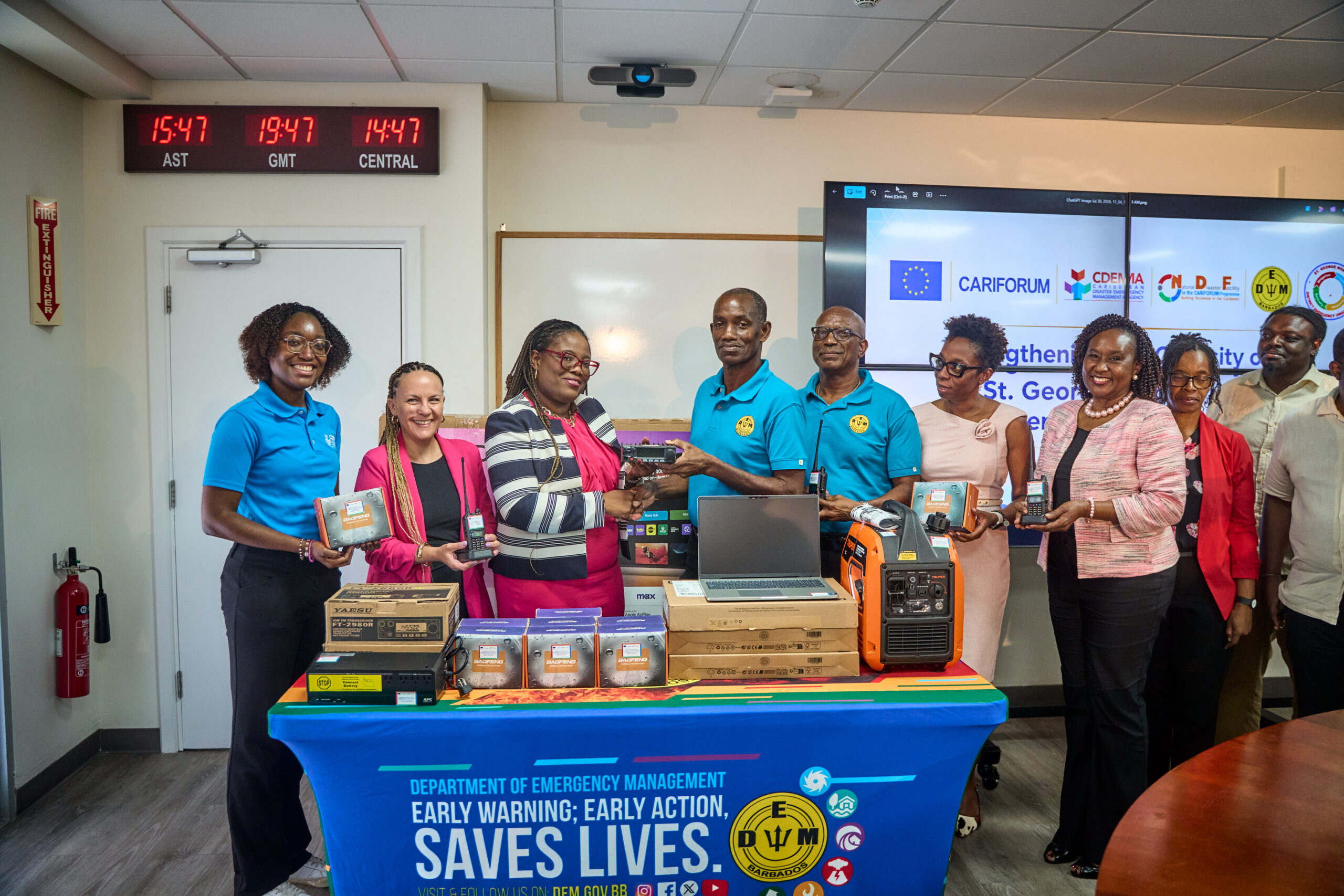
Community disaster response capabilities in Barbados’ rural St George North constituency are set for a major upgrade, after the country’s Department of Emergency Management (DEM) formally handed over a new cache of emergency tools and infrastructure, delivered through a regional climate and disaster resilience project backed by the European Union.
The handover ceremony took place at DEM headquarters located at No. 24 Warrens Industrial Park, marking a key milestone for the Building Resilience of CARIFORUM States to Disaster Risks and Climate Change Impacts (BRICS) programme, a regional initiative managed by the Caribbean Disaster Emergency Management Agency (CDEMA). The project is specifically designed to strengthen local district emergency organisations (DEOs) across participating Caribbean states, with this intervention focused on expanding community-level response capacity in St George North.
Roderick “Rickie” Yarde, Chairman of the St George North DEO, framed the handover as a transformative step forward for the district’s ability to prepare for, respond to and recover from extreme weather and other emergency events. “Today represents the strengthening of community resilience, improved operational readiness and a significant advancement in the capacity of the Saint George North District Emergency Organisation to support disaster preparedness, response, and recovery efforts within our district,” Yarde said.
The initiative traces its origins back to a collaborative agreement signed between DEM and CDEMA in April 2022, crafted to address gaps in local emergency coordination capacity for rural communities. The new equipment will be fully deployed to outfit St George North’s new Satellite Emergency Operations Centre (SEOC), a mobile on-the-ground hub that will streamline response coordination and ensure seamless information sharing when disasters disrupt regular communications and operations.
“As a district emergency organisation, we have a responsibility to support the mandate of the Department of Emergency Management and contribute to the wider objectives of the National Emergency Management System. This investment provides the St George North DEO with additional capacity to better fulfil that responsibility,” Yarde added.
However, Yarde emphasized that hardware alone is not enough to guarantee effective response, noting that human capacity remains the core of successful emergency management. “Equipment alone does not create capacity. People do,” he said. In line with this approach, all volunteers assigned to the new SEOC will complete comprehensive training on equipment use, maintenance and management, with regular simulation exercises and drills scheduled to refine response protocols and test operational readiness on an ongoing basis.
Andria Grosvenor, CDEMA’s Planning and Business Development Manager, extended gratitude to the European Union for its sustained support of the BRICS programme, which has allowed the regional body to embed disaster resilience capacity directly at the community level across the Caribbean. “We have been able through the BRICS programme to work alongside our participating states to deliver investments that respond directly to nationally identified priorities,” Grosvenor explained.
She also highlighted Barbados’ regional leadership in proactive disaster preparedness, noting that the country has prioritized building resilience from the grassroots upward. “Barbados has consistently demonstrated leadership in identifying initiatives that strengthen disaster preparedness from the community level upward, ensuring that resilience begins where disasters are first experienced – in our communities,” she said.
Toni Moore, Member of Parliament for St George North, welcomed the new equipment donation, noting it represents the culmination of years of collaborative advocacy and planning to improve emergency outcomes for the inland constituency. She drew attention to the unique disaster risks faced by inland communities that are often overlooked in resilience planning, explaining, “When you are in the centre of the country…you tend to feel [disasters] in a different way when it comes to drainage and freak acts of nature.”
Moore framed the new investment as a key step in a long-term commitment to community safety, adding, “Resilience is something that has to be a journey for all of us.”