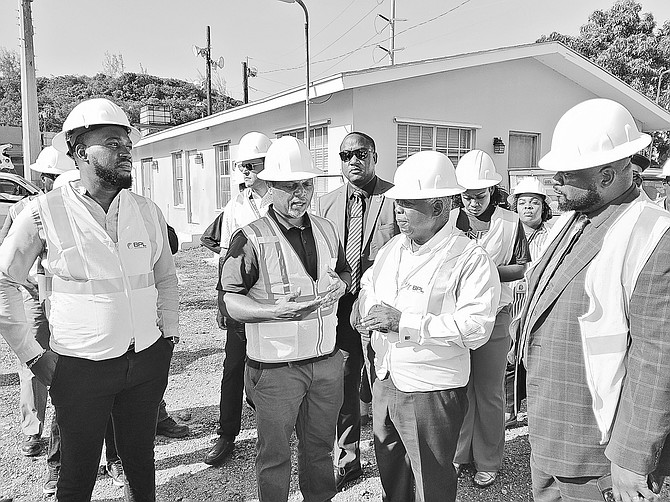
A total island-wide power outage that brought daily life across New Providence to a standstill has sparked intense public scrutiny of the Davis administration’s energy policy, just weeks after officials insisted the national utility was fully prepared to meet peak summer demand. The shutdown, triggered by an electrical fire at Bahamas Power and Light (BPL)’s Blue Hills Power Station, left thousands of residents trapped in sweltering, unairconditioned homes, forced business closures, and disrupted commercial air travel through Nassau’s major airport.
In a press briefing held hours after power was cut, Prime Minister Philip Davis pushed back against critics who have pinned the blame for the outage on poor infrastructure maintenance or insufficient action by his administration. He framed the incident as the result of uncontrollable external factors, pointing to record-breaking regional heat that has strained the Bahamas’ already outdated electricity network beyond its designed limits.
According to preliminary findings from BPL, an undetermined fault in an underground cable sparked a fire that damaged a 15 MVA transformer, triggering a cascading failure that shut down generation at both the Blue Hills and Clifton Pier power stations. Investigations into the root cause of the initial cable fault are still ongoing, with no definitive conclusion reached as of the briefing.
Davis pushed back against claims of human error or institutional neglect, asking: “You have a transformer that’s blown up because of overheating of underground cables, was that man’s fault? The excessive heat, the record heat that we are experiencing over the last several months. May, for example, was the hottest in history. June — same thing.” He added that persistent extreme temperatures have overwhelmed the country’s aging transmission and distribution network, which his administration inherited when it took office.
The Prime Minister also revealed long-standing systemic gaps that have complicated infrastructure maintenance and incident response: decades of institutional turnover at BPL and its predecessor, the Bahamas Electricity Corporation, have left the utility without a complete centralized inventory mapping the location of all underground cables, erasing critical institutional knowledge of the national grid.
Davis warned Bahamians to brace for additional power disruptions in the coming months as the government undertakes a sweeping overhaul of BPL’s outdated infrastructure, much of which has already reached the end of its planned service life. “There will be growing pains to get to where we need to be because of what we inherited,” he said. “Incidents like these remind us of the state of play of BPL.”
To address public anger over the outage, Davis confirmed he has directed BPL leadership to explore potential financial concessions for residential and commercial customers affected by the shutdown, with the utility set to announce what relief it can offer in the coming days.
He also pushed back against claims that the crisis is a unique failure of Bahamian governance, noting that power grid disruptions linked to extreme heat have become increasingly common across the globe. Still, he stressed that his administration is prioritizing aggressive grid modernization, pointing to ongoing transmission and distribution upgrades, new substation construction, and a major renewable energy project at the Blue Hills site that will add 20 megawatts of solar generation and 25 megawatts of battery storage once completed.
BPL’s top leadership has echoed Davis’s framing, while acknowledging gaps in the utility’s contingency response and apologizing to the public. Chief Operating Officer Anthony Christie suggested the underground cable likely had an undiagnosed pre-existing fault that was exacerbated by extreme peak electrical demand amid the heat wave, triggering a chain reaction that damaged nearby cables as well. He denied that poor maintenance contributed to the incident, though he confirmed the full investigation is still ongoing.
Executive Chair Christina Alston acknowledged in a formal statement that BPL’s contingency plans have clear limits when multiple critical failures occur in close succession. “That is not an excuse. It is the reality we’re confronting — and responsibility we understand,” she said, adding that public trust can only be restored through tangible, measurable improvements to service reliability and communication, not just verbal assurances.
BPL Chief Executive Officer Toni Pratt offered a public apology to New Providence residents, acknowledging the severe discomfort the outage caused during a period of extreme heat. “We know that it is very, very hot, and we understand your frustration. We are working as safely and as quickly as we possibly can to restore supply,” she said. As of the latest updates, power has been systematically restored to most parts of the island, though limited outages persist in some areas while final repairs are completed.
Bahamas Grid Company Chief Operating Officer Ryan Holder said repair crews began assessing the damaged transformer overnight, with total repair work projected to take between eight and ten hours. Crews have been working around live energized infrastructure to excavate the affected area, install new protective conduit, and lay replacement transmission cable.
This outage marks one of the worst summer power outage events the Bahamas has seen in a decade, an issue that has become a key political measuring stick for sitting administrations, renewing public pressure on the Davis government to deliver on its promises of grid reliability.