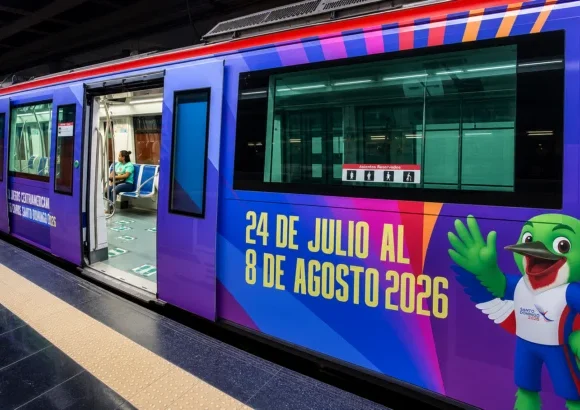
As preparations ramp up for the 2026 Central American and Caribbean Games, Santo Domingo has unveiled a series of mobility-focused policy measures designed to support smooth operations during the major international sporting event, which runs from July 24 to August 8 next year. The most impactful change for local residents and visitors alike is a full free fare policy covering all three major public transit systems operated in the capital: the Santo Domingo Metro, the city’s cable car line, and all buses run by the Oficina Metropolitana de Servicios de Autobuses (OMSA).
Event organizers confirmed the free transit initiative is a core component of the Games’ comprehensive mobility strategy, crafted to address two key priorities. First, the policy aims to eliminate travel barriers for the more than 6,000 participating athletes, international officials, event volunteers, and tens of thousands of expected spectators, making it simpler for all groups to reach competition venues across the city. Second, waiving transit fares is designed to incentivize shifted travel away from private vehicles, cutting down on anticipated traffic congestion that would otherwise disrupt daily life in the capital during the two-week event.
In addition to free public transit, organizers have rolled out further accessibility and flow improvements for key venue areas. The Juan Pablo Duarte Olympic Center, the primary Games hub, and Parque del Este, another major venue cluster, will be converted into fully pedestrian-only zones for the duration of the competition. To accommodate private vehicle arrivals, new designated peripheral parking lots have been planned outside these restricted zones, with frequent free shuttle services connecting parked cars to venue entrances, streamlining access for attendees who choose to drive.
The 2026 Santo Domingo edition of the Games carries special historic significance: it marks exactly 100 years since the first Central American and Caribbean Games were held, making this a landmark celebration of regional sporting unity. Over the course of 16 days of competition, 6,000 athletes from 37 nations across the region will compete across 40 distinct sports and 57 different disciplines, vying for regional titles and celebrating a century of cross-cultural athletic exchange.