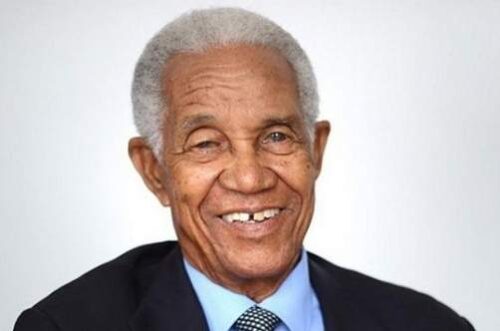
Barbados is preparing to honor one of its most iconic figures and greatest sporting legends with a full State Funeral, following the passing of National Hero Sir Garfield St Aubrun Sobers on Friday morning, just 11 days before what would have been his 90th birthday. Within hours of his death, which occurred at approximately 9 a.m., Prime Minister Mia Mottley announced immediate national measures to mourn the iconic cricketer, declaring the day of his passing a national day of mourning and ordering all national flags across the country to be flown at half-mast until his interment. Mottley confirmed that the man who held Barbados’ highest civilian honor in life would receive the nation’s highest posthumous tribute, a state funeral, in recognition of his extraordinary contributions to the country and global sport. In a televised address to the nation, Mottley framed Sir Garry’s death as a moment of profound collective loss, felt not just across Barbados, but throughout the entire Caribbean and the global cricketing community. “It is with profound sadness that I now advise the people of Barbados, the region and the wider cricketing world of the passing of The Right Excellent Sir Garfield St Aubrun Sobers, our beloved Sir Garry,” she said. A second national day of mourning will be held on the day of Sir Garry’s interment, with all official government functions canceled and flags remaining at half-staff through the conclusion of the state funeral. A coordination committee led by Senator Lisa Cummins, working alongside the Cabinet Office and the Barbados Defence Force, has been assembled to organize the ceremonial proceedings, with additional details of the funeral schedule expected to be released publicly in the coming days. Sir Garry’s passing closes the book on an extraordinary life that extended far beyond the boundaries of the cricket pitch, playing a central role in shaping Barbados’ global identity and placing the small Caribbean nation on the world sporting map. Born into humble working-class beginnings in the Bay Land neighborhood of St Michael, Sobers rose from local community pitches to become one of the most revered figures in the history of international cricket, earning global acclaim for his unmatched versatility as a batsman, bowler and fielder that set him apart from his peers. He made his Test debut for the West Indies at just 16 years old in 1954, and over the next two decades established himself as the global benchmark for all-round cricketing excellence. His iconic unbeaten 365-run innings against Pakistan in 1958 stood as the highest individual score in Test match cricket for 36 years, while his historic feat of hitting six sixes from a single over bowled by Malcolm Nash, playing for county side Nottinghamshire against Glamorgan in 1968, remains one of the most celebrated achievements in the sport’s history. In 1975, Queen Elizabeth II knighed him for his services to cricket during a public investiture ceremony held at the Garrison Savannah, an event that remains unique in British and Commonwealth history. He was named a National Hero of Barbados in 1998, becoming the first and only living holder of that honor until 2021. That same year, he was awarded the Order of the Caribbean Community, adding to a long list of honors that included an honorary Doctor of Laws from the University of the West Indies in 1992 and appointment as an Officer of the Order of Australia in 2003. Beyond his on-field achievements and formal accolades, Sir Garry served as one of Barbados’ most recognizable and effective cultural ambassadors, even after retiring from professional cricket. He launched an international schools cricket competition that bears his name, which provided a platform for emerging young Caribbean talent – most notably a young Brian Lara, who would go on to break Sobers’ 36-year Test scoring record and cement his own status as a global batting legend. Reflecting on Sobers’ enduring legacy, Mottley emphasized that his greatness extended far beyond statistical records on the cricket field. “He is remembered as the greatest cricketer, the greatest all-rounder the world has ever seen, not simply because of his records, but because he became the standard by which greatness would forever be measured,” she said. His life trajectory, Mottley noted, stood as a powerful example of how raw talent, relentless discipline and perseverance could lift a young person from humble beginnings onto the global stage. “Sir Garfield St Aubrun Sobers, our Sir Garry, did not begin life among privilege or parade. He began in Walcott Avenue, Bay Land, a boy of Barbados, shaped by family, community, loss, discipline and faith. He travelled from Bay Land to Kensington, from Kensington to Sabina Park, and onto the world stage, carrying Barbados, carrying the West Indies and carrying the Caribbean as a whole with distinction,” Mottley added. The prime minister emphasized that Sobers’ influence transcended sport, framing him as a global symbol of excellence whose achievements instilled enduring national pride across Barbados and the entire Caribbean. Born on July 28, 1936, Sobers experienced profound loss at a young age: when he was just five years old, his father, a Merchant Navy seaman, was killed at sea when his ship was torpedoed by a German U-boat in January 1942 during the Second World War. His mother Thelma raised Sobers and his five siblings alone; his brother Gerald would go on to become a skilled cricketer in his own youth. Educated at Bay Street Boys’ School, Sobers honed his skills on the Bay Pasture, now the playing field of Bay Primary School, and earned a spot playing first-division cricket for the Police Club by age 15, making his first-class debut that same year as a lanky, athletic left-arm bowler. In a tribute released on behalf of the Barbados Police Service, Commissioner of Police Sonia Boyce described Sir Garry as far more than a cricketing legend, noting that his personal discipline, humility and deep love for his country inspired generations of young Barbadians, and will continue to serve as a model for young people striving to reach their full potential. After earning his call-up to the West Indies national Test side as a teenager in 1954, Sobers developed into the most complete cricketer of his era, and is still widely regarded as the greatest all-rounder to ever play the game. Over a 20-year international career spanning 93 Test matches between 1954 and 1974, he scored 8,032 runs at an average of 57.78, including 26 centuries and 30 half-centuries. He also took 235 wickets using a rare combination of fast-medium pace and spin bowling, and claimed 109 catches. Remarkably, these statistics were achieved in an era of uncovered pitches, before the introduction of protective batting helmets, and with far fewer scheduled international matches than modern cricket. These numbers place him among the greatest specialist batters in history even before accounting for his bowling and fielding contributions. A rare complete all-rounder, he was a left-handed batter with breathtaking range and authoritative strokeplay, a brilliant close fielder, and a bowler capable of switching between three distinct styles: fast-medium pace, orthodox left-arm spin and left-arm wrist spin. Legendary Indian spinner Bishan Singh Bedi once described Sobers as “God’s own contribution to world cricket”. He captained the West Indies in 39 Test matches between 1965 and 1972, leading the side to a famous 3-1 series victory over England in 1966. Cricket authorities and legends of the game have repeatedly ranked Sobers at or near the top of the sport’s all-time pantheon. After Sobers scored 254 runs for the World XI against Australia in Melbourne in 1972, Sir Donald Bradman – widely considered the greatest batter of all time – said of the innings: “Having seen all the players of the last 50 years, I believe that Sobers’ was the greatest exhibition of batting seen in Australia. I have seen nothing equal to it in this country.” Wisden Cricketers’ Almanack named Sobers one of the five greatest cricketers of the 20th century, and he was inducted into the ICC Cricket Hall of Fame in 2009. In the days following his passing, tributes have continued to pour in from across the global sporting community and beyond, as Barbadians mourn the loss of the man widely regarded as the greatest all-round cricketer the game has ever seen, and the first global celebrity of independent Barbados. Off the field, Sobers married Australian television presenter Prudence “Pru” Kirby in September 1969, while playing for Nottinghamshire in England. The marriage, which ended in divorce in 1990, produced two sons, Matthew and Daniel, and an adopted daughter, Genevieve. His long-term partner Jackie White passed away earlier in 2025. He is survived by stepchildren Stuart and Trisha, six grandchildren, and his brother Cecil. Closing her national address with an emotional farewell, Mottley said: “Sir Garry, Barbados stands for you. The West Indies stands for you. The world stands for you. For an innings that was so well played, Sir Garry, so well played. We will always love you.”