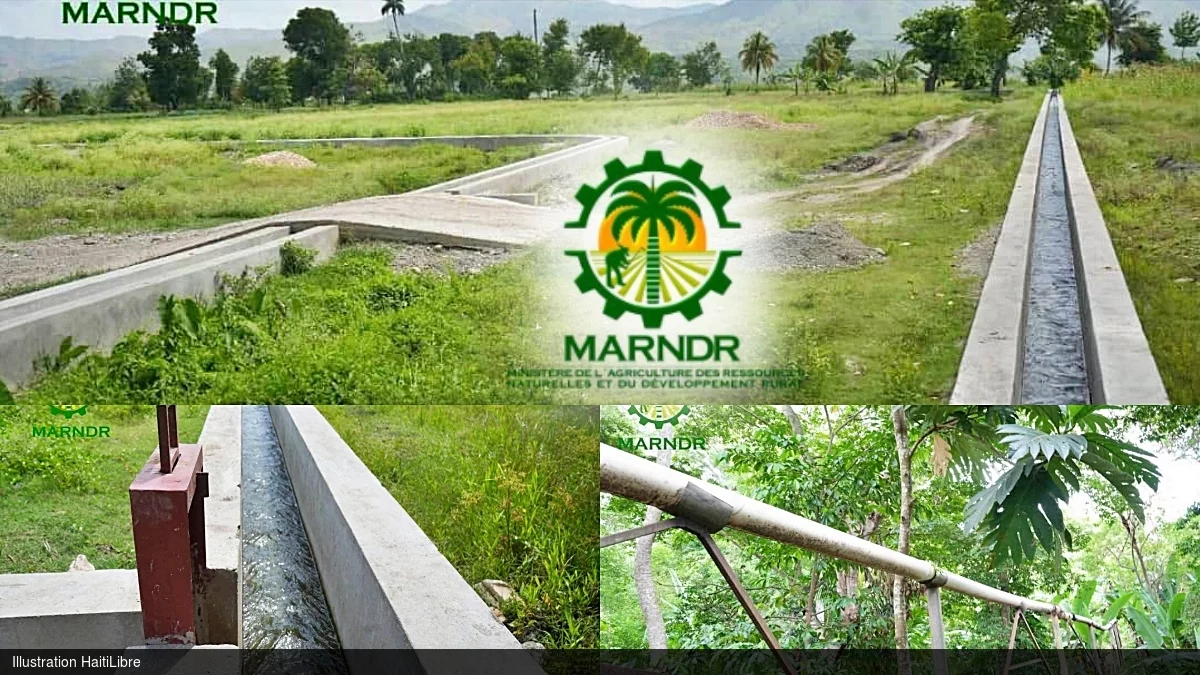
Against a backdrop of worsening climate volatility and widespread environmental degradation that has threatened Haiti’s food security for years, the country’s Ministry of Agriculture, Natural Resources and Rural Development (MARNDR) is advancing a targeted infrastructure upgrade initiative across the Central Department. Delivered through the Resilient Agriculture for Food Security Project (PARSA), the program combines hands-on community participation with targeted technical support to strengthen local irrigation associations and watershed management governing bodies, putting decision-making power in the hands of the producers who rely on these systems most.
The upgrade work is concentrated across three high-priority agricultural zones: the Gros Trou irrigated perimeter in Cerca-Carvajal, the Abricot growing area in Cerca-la-Source, and the Cave basin in Maïssade. Each site is receiving tailored interventions to address unique water access and management challenges, all aligned with the core project goals: improving irrigation water control and stewardship, boosting agricultural output through crop diversification and higher yields, and increasing the overall productivity of Haiti’s key irrigated farmland.
For smallholder producers in Cerca-Carvajal, the infrastructure upgrades have already delivered transformative, life-changing results. Pierre-Louis Décimus, president of the Farmers’ Association of the Labocque Community (APCL), explained that prior to the project, water access was an almost insurmountable barrier to production. The region’s original natural catchment area could not hold water due to the local terrain, with most runoff draining straight into nearby ravines before it could reach farm plots. Before the upgrades, only around 60 local producers were able to grow vegetables at any time. Today, after MARNDR and PARSA reinforced the catchment area, between 500 and 600 producers now have reliable access to irrigation water. A transparent rotation system, organized alphabetically, guarantees every producer gets a full day of water access to tend their crops each cycle.
The Gros Trou rehabilitation project includes a sweeping set of infrastructure improvements designed to cut water waste and expand irrigated farmland. Core works include replacing corroded and leaking primary and secondary irrigation pipes, constructing five new distribution basins, installing four master control valves and eight local distribution valves, rebuilding crossing structures over the Discipline and Sylvain ravines, and extending the pipe network to reach previously unirrigated plots. The expansion adds 390 linear meters of 6-inch main pipe, 280 meters of 4-inch main pipe, 234 meters of 6-inch secondary pipe, and 450 meters of 4-inch secondary pipe to the network. Complementary upgrades to local farm roads are also underway to improve access to production zones, including the installation of crossing slabs over the Carrefour Laboc drainage canal, clearing overgrowth from existing drainage ditches, adding compacted fill to eroded road sections, constructing new roadside drainage features and river swales measuring 7.4 meters long by 4 meters wide, and widening all paths to a minimum usable width of 3.5 meters.
In Cerca-la-Source’s Abricot irrigated perimeter, rehabilitation work focuses on cutting seepage loss that has long wasted the region’s limited water supply. Teams are extending existing masonry canal sections, which have far lower infiltration rates than earthen canals, to improve overall system efficiency. The project also adds new storage reservoirs and control valves to give farmers more precise control over water distribution. Specific works here include 900 meters of new primary canal, 650 meters of primary secondary canal, 450 meters of secondary canal, nine new distribution reservoirs, and 21 new valves and sluice gates for water regulation and distribution. Complementary agricultural track upgrades will improve access to growing areas and manage rain and irrigation runoff, including clearing overgrowth, leveling road surfaces, widening tracks to a minimum of 4.5 meters, clearing drainage easement areas, constructing new drainage ditches, installing a culvert for canal crossing, repairing eroded track sections with compacted fill, and adding three dedicated runoff evacuation ditches at key points along the track network.