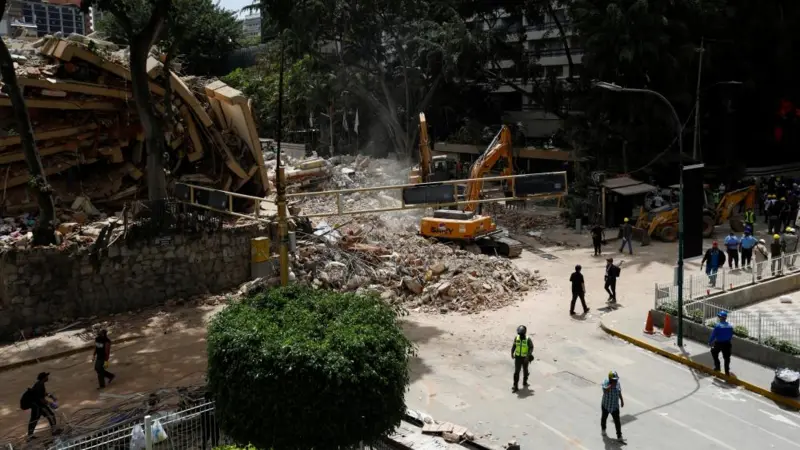
A pair of powerful back-to-back earthquakes that devastated coastal Venezuela this week has reignited urgent warnings for residents of nearby Barbados to prioritize earthquake and tsunami readiness, as disaster management officials emphasize the island nation’s persistent geological risk in a seismically active zone.
The unfolding disaster began Wednesday evening, when two tremors measuring magnitudes 7.2 and 7.5 struck off Venezuela’s northern coast less than 60 seconds apart. As of the latest updates, the disaster has claimed at least 164 lives, flattened widespread infrastructure across affected regions, and launched a large-scale multinational search-and-rescue operation focused on pulling survivors from collapsed buildings. Acting Venezuelan President Delcy Rodríguez confirmed that La Guaira, a coastal state located just north of the capital Caracas, suffered the most severe damage and loss of life.
According to the United States Geological Survey (USGS), the second of the two quakes was the most powerful seismic event to hit Venezuela since 1900, and the agency has warned that the final death toll is likely to climb substantially as rescue teams work to reach remote and heavily damaged areas.
In the immediate aftermath of the Venezuelan quakes, regional seismic and tsunami monitoring systems quickly dispatched an alert to Barbadian authorities, outlining a potential tsunami risk for the island, Department of Emergency Management (DEM) Deputy Director Major Robert Harewood explained in an exclusive interview with Barbados TODAY.
“Barbados’ meteorological services received an official tsunami information statement noting that the size of the earthquake created a non-zero possibility of a tsunami reaching our coast,” Harewood said. “Because both earthquake and tsunami threats — especially tsunamis — demand immediate public awareness, we cut through all bureaucratic red tape to share the alert directly with media outlets and emergency response teams right away, no delays.”
Within a short window, a follow-up assessment confirmed that no tsunami posed a danger to Barbados, but the incident served as a critical wake-up call for the island’s population, which sits in a geologically vulnerable region long identified as overdue for a major seismic event.
Harewood noted that Barbados has made significant investments in recent years to upgrade its emergency alert infrastructure, rolling out the Common Alerting Protocol that allows authorities to push time-sensitive warnings directly to the public via participating local radio stations. “Right now, we have at least six radio stations across the island equipped with the technology to broadcast emergency messages immediately when we issue an alert, and that network has expanded in recent years,” he added.
The DEM deputy director emphasized that the recent Venezuelan disaster is a stark reminder of Barbados’ inherent seismic risk: the island sits just adjacent to the subduction zone boundary where the Atlantic tectonic plate meets the Caribbean plate, the very geological force that created Barbados through tectonic uplift centuries ago. “The fact of our creation alone tells us we live in a susceptible area,” Harewood explained. “While major earthquakes are low-frequency events here, seismologists have repeatedly warned that the Caribbean basin is long overdue for a large-scale seismic event.”
He pointed to a string of recent seismic activity across the region to underscore the ongoing risk: the 7.5 quake that hit Venezuela this week is the largest recorded in the country in more than a century, the Seismic Research Center records measurable seismic activity across the Caribbean almost every week, a magnitude 6+ tremor was recorded off Barbados’ own coast just a few weeks ago, and a significant quake struck near Antigua just a few years back.
Unlike Atlantic hurricanes — which give days of advance warning to prepare, evacuate, and secure property — earthquakes offer no lead time for preparation, a key difference that makes ongoing public readiness all the more critical, Harewood argued. “With hurricanes, we see them coming days in advance. We can board up our homes, move to safe shelter, and prepare supplies. With earthquakes, there is no warning. There’s no time to shut down infrastructure, and there’s no advance all-clear to plan around,” he said.
Harewood added that Wednesday saw major seismic events strike not just Venezuela, but also California and Japan, underscoring that the risk is global and constant. He encouraged all Barbadians to learn from the ongoing crisis in Venezuela, study how survivors navigated the disaster, and take proactive steps to prepare their households. “There is no magic bullet that eliminates earthquake risk entirely,” he noted. “The best thing we can do as a community is understand our vulnerabilities, learn from past disasters elsewhere, and know what to do when an earthquake hits.”
In addition to preparing emergency kits and identifying safe spots in homes and workplaces, Harewood urged residents to pursue first aid and life-saving training, so they can assist themselves and others in the critical window after a major quake before emergency response teams can reach every affected area. “We have distributed plenty of public guidance outlining what hazards to look for, what steps to take during and after a quake, and what challenges we may face,” he said. “The goal is for every person to understand what they can do to survive, and to take steps to be ready before a disaster strikes.”