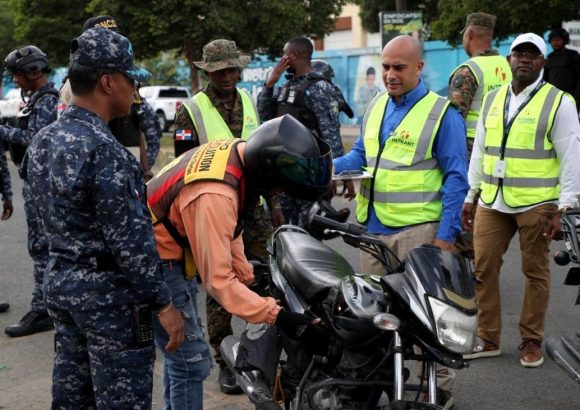
Between June 3 and June 24, Dominican Republic’s transportation and law enforcement agencies carried out a sweeping nationwide operation to bring order to the country’s informal motorcycle taxi (locally known as motoconcho) sector, marking one of the largest coordinated regulatory actions targeting the industry in recent years.
The multi-agency initiative was led by the National Institute of Transit and Land Transportation (INTRANT), with support from a coalition of security bodies including the National Police, the Dominican Drug Control Directorate (DNCD), the Specialized Directorate for Land Transit Safety (DIGESETT), the Criminal Investigation Directorate (Dicrim), the General Directorate of Migration, and municipal police forces across the country. The operation centered on three core priorities: physical inspections of informal pickup stands, document verification for drivers and vehicles, and background checks to screen for outstanding violations or irregularities, all as part of a long-term government push to formalize the unregulated motoconcho industry that serves millions of commuters across the country.
INTRANT Executive Director Milton Morrison outlined that the ultimate goal of the operation is to bring thousands of currently informal motorcycle taxi drivers into the country’s formal transportation system, while cutting down on rampant road safety violations that have made motoconchos a major contributor to traffic fatalities in the Dominican Republic. By the end of the three-week enforcement period, authorities released a detailed breakdown of results: teams inspected 488 separate motorcycle taxi stands across 11 major regions of the country, including Greater Santo Domingo, Santiago, La Vega, and Barahona. Officials processed 2,808 new driver registrations, completed 1,570 full vehicle and driver inspections, impounded 599 unregistered or non-compliant motorcycles, and took 63 individuals into custody on outstanding charges or regulatory violations. Additionally, 414 drivers were administered breathalyzer tests to check for drunk driving, six unlicensed informal stands were permanently closed, two more were relocated to compliant designated zones, four public spaces previously appropriated by illegal stands were reclaimed for community use, and 42 drivers found to hold irregular immigration status were turned over to migration authorities for processing.
Alongside enforcement actions, government officials also highlighted encouraging progress in voluntary compliance, noting a dramatic surge in motorcycle license applications over the past quarter. Between March and June 2026, INTRANT processed a total of 14,888 motorcycle license applications, 12,331 of which were from first-time applicants seeking new licenses. Data shows that applications for the new Category 1 motorcycle license, the required credential for operating commercial motorcycle taxis, jumped by 107.5% over the three-month period, rising from just 1,843 applications in March to 3,824 in June. This sharp increase officials say, signals growing recognition among motoconcho drivers of the benefits of formalizing their status and complying with national transit regulations.
Moving forward, INTRANT confirmed that joint multi-agency operations will continue across all regions of the country, with the agency reiterating its commitment to strengthening national road safety, fully formalizing the commercial motorcycle transportation sector, and ensuring full compliance with Law 63-17, the country’s overarching legislation governing transit and land transportation.