On a diplomatic visit to Cuba this Sunday, Vietnam’s Foreign Minister Le Hoasi Trung, who also serves as a member of the Political Bureau of the Central Committee of the Communist Party of Vietnam, has delivered a clear message of unwavering solidarity: Vietnam will stand with Cuba, regardless of the prolonged economic siege imposed by the United States government.
Le’s trip to the Caribbean island included stops at two of the most prominent bilateral cooperation projects, the Mariel Special Development Zone (ZEDM) and a joint rice production initiative in Pinar del Río province, designed to assess ongoing progress and strengthen economic ties between the two longstanding partners.
The Vietnamese delegation’s first stop was ViMariel S.A., a fully foreign-owned Vietnamese firm that has operated in Cuba since 2019 and holds the sole 50-year concession for ZEDM’s industrial park development. Ana Teresa Igarza Martínez, General Director of the special development zone, noted that Vietnam already holds the title of the country with the second-largest business footprint within the enclave.
Le explained that the visit grew directly out of agreements reached by the party and state leaders of both nations in 2024, created to give officials a first-hand look at how Vietnamese enterprises are performing across multiple key sectors of Cuba’s economy. These sectors span from manufacturing, agri-food production, consumer goods including disposable diapers and detergents, and renewable energy development, to trade, finance and banking. With Cuba’s National Assembly having recently passed a suite of economic reforms aimed at revitalizing foreign investment and supporting existing businesses, Igarza emphasized that both sides must continue deepening collaborative work to capitalize on these new opportunities.
Reaffirming the fraternal bond between the two peoples, Le made clear that Vietnam’s commitment to Cuba remains unshaken by external pressure. “The Vietnamese people are driven by brotherhood, and we will never abandon Cuba despite the siege imposed by the United States government,” he stated. He also reiterated Vietnam’s commitment to expanding investment where it is most needed, creating new opportunities for Vietnamese entrepreneurs while supporting Cuba through its current challenging economic context.
Huona Nauyen, Office Head and Business Manager of ViMariel S.A., outlined the scope of the company’s work in ZEDM: the 50-year concession grants ViMariel the right to plan, invest in, construct, manage and operate industrial park infrastructure across nearly 300 hectares of land in the Artemisa province enclave, as the firm moves forward with its expansion plans.
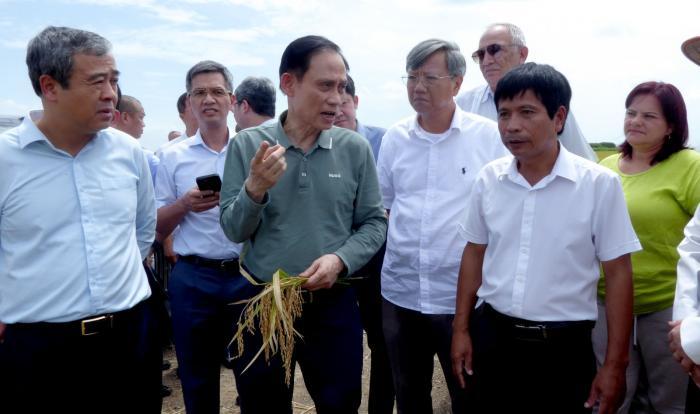
After concluding his visit to ZEDM, Le and his delegation traveled to Pinar del Río to inspect the bilateral rice production project that has become a model of successful agricultural cooperation between the two nations. As of 2026, more than 900 hectares of land have already been planted this growing season, with yields exceeding initial expectations and planting work continuing. Le praised the high quality of Pinar del Río’s soils, noting that Vietnamese technical partners already achieved strong yields in 2025 on far less fertile land.
Yamilé Ramos Cordero, First Secretary of the Provincial Party Committee in Pinar del Río, told the visiting delegation that the province holds additional high-quality arable areas that could be incorporated into the joint project, saying local authorities are deeply interested in expanding the successful initiative. Alongside touring growing fields at multiple development stages, including plots already being harvested, Le visited the on-site industrial processing complex where the rice, destined for Cuban domestic consumption, is prepared. He commended the high quality of the finished grain produced through the partnership.
Even as the U.S. economic blockade continues to exert severe pressure on Cuba’s economy and disrupt cross-border projects, the rice initiative has kept moving forward, with local and Vietnamese partners finding workarounds for every challenge that has arisen, according to Telce González Morera, Cuba’s Deputy Minister of Agriculture. González Morera added that a smaller-scale similar project is already operating in Cuba’s Granma province, but the Pinar del Río initiative remains the most advanced and well-established, having operated for a longer period. “They had a successful campaign last year, and the current one is progressing well, with planting and harvesting yields above the national average, becoming more efficient every day, and forging stronger relationships with producers,” he noted.
The visit underscores the deep, longstanding historical and political ties between Vietnam and Cuba, and reaffirms both nations’ commitment to expanding mutually beneficial economic cooperation even amid external pressure.