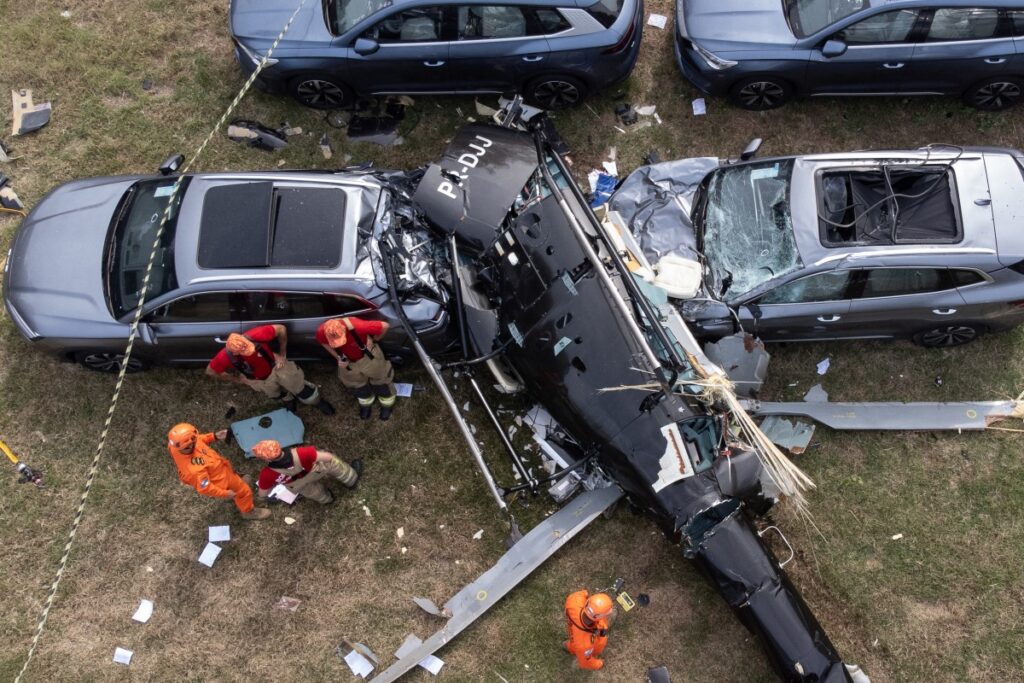
RIO DE JANEIRO, Brazil — A devastating mid-air collision between two helicopters left at least six people dead Sunday in Rio de Janeiro’s western suburb of Recreio dos Bandeirantes, local fire department officials confirmed. Both aircraft plummeted into the open-air parking lot of a local electric vehicle dealership after the crash, triggering an intense blaze that consumed at least 20 parked cars.
Early official statements from Rio’s fire department confirm all six fatalities were crew members on board the two collided helicopters. Rio de Janeiro Mayor Eduardo Cavaliere also confirmed that one of the aircraft carried foreign nationals, though he declined to release additional details including nationalities or identities of those on board as of Sunday afternoon.
Speaking to reporters on the scene, fire service spokesperson Lieutenant Colonel Fabio Contreiras noted that investigators still lack a clear timeline of how the accident unfolded. “Aircraft debris is scattered across hundreds of meters of the surrounding area, so all details we have at this moment remain preliminary,” Contreiras explained. “To piece together an accurate account of what led to the collision, we need to recover on-board flight recordings and review witness footage captured at the scene.”
Search and recovery teams documented one helicopter, carrying five crew members, that came to rest among the dealership’s electric vehicles and was immediately engulfed in flames; all five people on board were pronounced dead at the scene. The second helicopter, which crashed roughly 100 meters from the dealership lot, carried only a pilot, who also did not survive the impact.
Local media published images from the crash site within hours, showing a thick column of black smoke billowing hundreds of meters above the dealership, as multiple vehicles burned continuously through the initial response effort.
In a surprising silver lining, Contreiras emphasized that the crash location, an open parking lot away from crowded residential areas, prevented a far deadlier outcome. “Given the density of surrounding homes in this part of the suburb, the accident could have resulted in far greater loss of life on the ground,” he said.
First responders faced unique challenges tackling the blaze, Contreiras added, due to the large number of electric vehicles that caught fire. Lithium-ion batteries that power most electric vehicles create unusual hazards for fire crews: when ignited, they release toxic fumes, drive up blaze temperatures far faster than traditional fuel fires, and require vastly more water to fully extinguish. “Putting out a single electric vehicle battery fire requires three to four times the water needed for a conventional gasoline car fire,” Contreiras noted.
This collision marks the latest in a string of aviation accidents in Brazil, a continental-sized nation that ranks as the world’s fifth largest by geographic area, where small aircraft are a common mode of transit across vast distances. Just one month prior, a small fixed-wing plane crashed into a residential building in the southeastern Brazilian city of Belo Horizonte, killing both the pilot and co-pilot on board.
Preliminary data from Brazil’s Center for Investigation and Prevention of Aeronautical Accidents (CENIPA) shows that 84 aviation accidents have been recorded across the country in 2026 prior to Sunday’s collision, with 25 total fatalities recorded in those incidents.