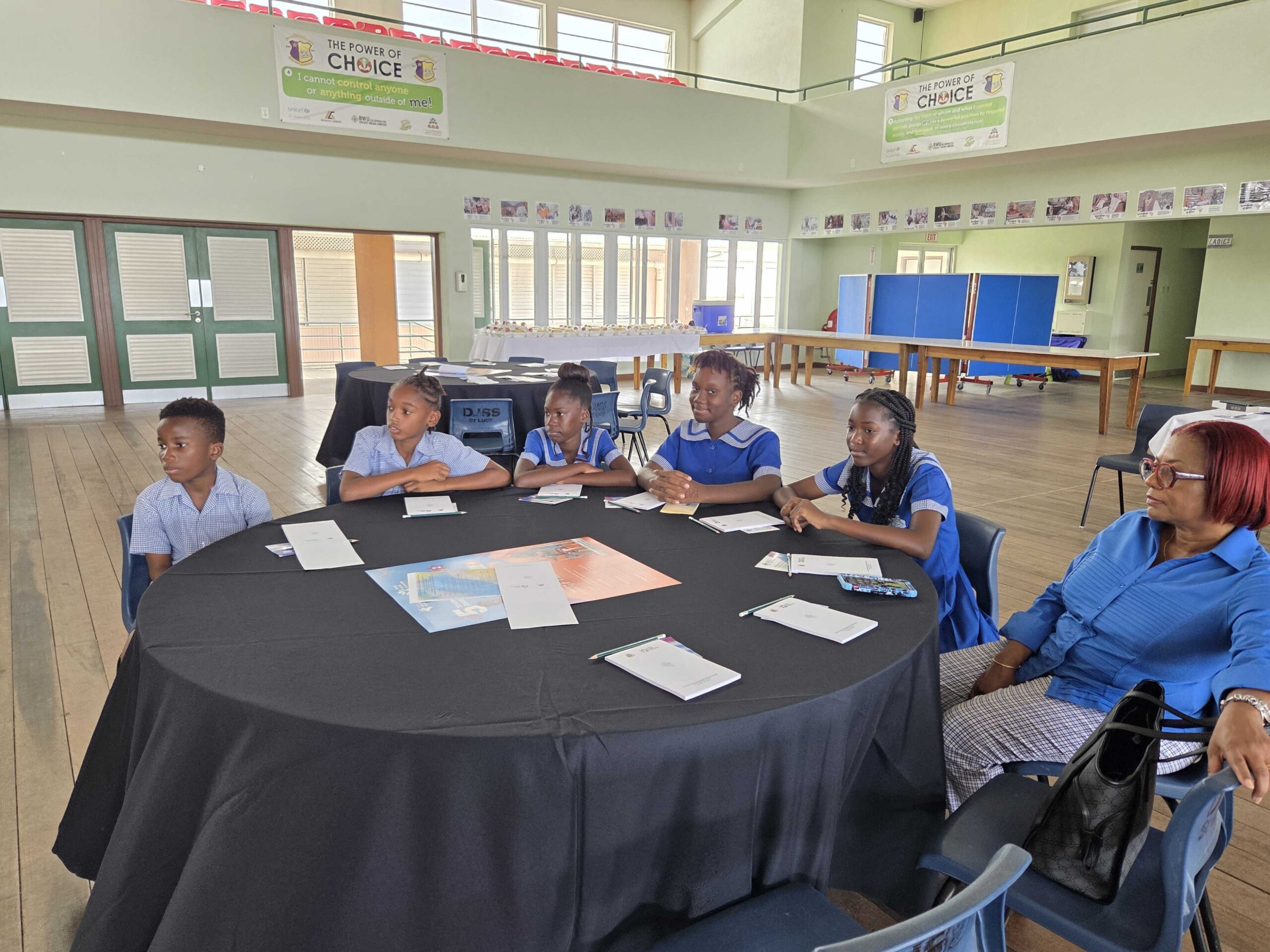
A national anti-child labour educational initiative has expanded its reach across Barbados, bringing interactive rights awareness to dozens of pre-secondary students in the island’s northern districts this week. Hosted at Daryll Jordan Secondary School, the forum marks the latest phase of a country-wide campaign led by the Ministry of Labour, Social Security and the Third Sector, timed to coincide with the upcoming World Day Against Child Labour and the International Labour Organisation’s global “Red Card to Child Labour” initiative.
Targeted at upper-level primary school pupils preparing to transition to secondary education, the event centered on protecting Barbados’ decades-long status as a territory with zero recorded cases of child labour. Eight primary schools across the northern region—including St Alban’s Primary, Ignatius Byer Primary, A. DaCosta Edwards Primary, St Lukes Academy, St Elizabeth Primary, St Joseph Primary, St Bernards and Elliot Belgrave Primary—sent hundreds of Class Three and Four students to participate, filling the venue’s auditorium. Only nearby St Lucy’s Primary was forced to withdraw after a recent local fire disrupted school operations.
Addressing the young audience, Rhonda Farley, a sitting member of Barbados’ National Child Labour Committee, opened by emphasizing that childhood must be preserved as a protected phase of growth and development. “Childhood is a time for learning, growing, playing, and dreaming, and a time when children should be in school,” Farley told attendees. “Unfortunately, that’s not the reality though for millions of children around the world.”
Farley highlighted the staggering global scale of the crisis: an estimated 138 million children between the ages of five and 17 are currently trapped in exploitative child labour across the globe. She asked the young Barbadian students to imagine starting full-time work at five years old, instead of attending classes and playing with peers, noting that many child labourers work grueling long hours just to contribute basic income to their struggling families.
Beyond long-recognized hazardous child labour in sectors like agriculture, mining and factory production, Farley drew urgent attention to a rapidly growing, underregulated threat: digital child exploitation enabled by online platforms. She explained that modern forms of hidden child labour are increasingly moving online, with children forced to create content for major platforms including TikTok and YouTube, compete in paid online gaming tournaments, sell goods directly to consumers, and complete repetitive digital microtasks for pay.
“While technology can be exciting and creative, it can also expose children to exploitation, long working hours, and online abuse,” Farley warned, citing recent UNICEF research that confirms the rising trend. She added that digital child labour is uniquely challenging to address, as it often operates underground, crosses national borders with ease, and falls outside existing regulatory frameworks designed for traditional work settings.
Farley stressed that no matter the setting—whether a physical farm, factory or an unregulated online space—excessive child labour inflicts irreversible harm: it disrupts school attendance, robs children of critical rest time, and stunts healthy social and emotional development. She went on to outline the strong protective framework Barbados has built to eliminate child labour, noting the country is a long-standing signatory to International Labour Organization Conventions 138 and 182. These global agreements set a minimum age for formal employment and ban the worst forms of child labour, including human trafficking, drug trafficking and commercial sexual exploitation.
Domestically, Barbadian law requires all children to remain in formal education until they reach 16 years old. To uphold this mandate, the national government allocates hundreds of millions of dollars annually to fund free education across primary, secondary and tertiary levels, alongside social welfare support including free school meals for students from low-income households.
Looking ahead, Farley revealed that the National Child Labour Committee is currently working to strengthen existing domestic legislation by developing a formal, definitive list of hazardous occupations. Once finalized, the register will explicitly ban all people under 18 from working in high-risk roles such as quarrying and work involving exposure to toxic chemicals.
This northern forum follows a similar successful event held in March for schools in and around the parish of Saint Michael, part of a coordinated national strategy to bring anti-child labour education to students across every region of the island. Unlike traditional lectures, the interactive event was designed to empower young people to become active participants in protecting children’s rights, rather than passive observers of the issue. Students who correctly answered questions about Barbadian labour history and global child labour statistics were awarded prizes, fostering a lively, engaged atmosphere throughout the day.
Farley closed by encouraging the young attendees to become advocates for children’s rights. “An advocate is someone who speaks up for others, raises awareness about important issues, and encourages positive change,” she said. “As young people, you have the power to educate others, to challenge harmful practices, and to promote the rights of every child to learn, play, and grow in a safe environment. We are going to raise our voice, we are going to speak up, and we are going to speak out.”