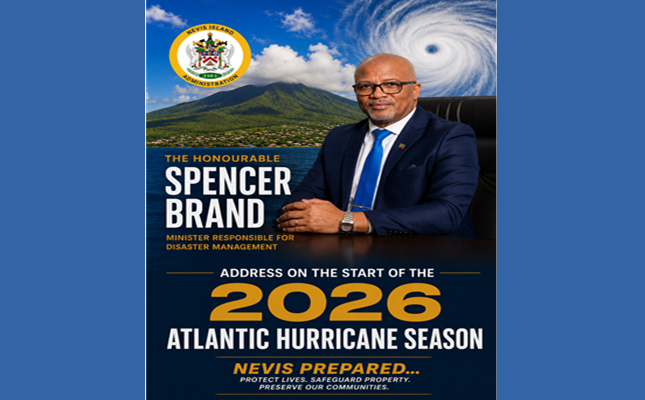
Marking the official start of the 2026 Atlantic Hurricane Season on June 1, Honourable Spencer Brand, the Nevis Island Administration’s Minister responsible for Disaster Management, has delivered a public address urging collective preparedness across the Caribbean island, even amid forecasts for a quieter-than-average storm cycle.
Opening his remarks, Brand emphasized that shared unity and proactive planning have long been Nevis’ most reliable defense against extreme weather, drawing on the island’s past experience navigating hurricane threats. He highlighted two core institutional commitments the government is reinforcing for this season: turning forecast data into prompt, actionable action for all groups, and centering communities in emergency response.
Under the first commitment, meteorological data from leading agencies will be used to issue timely public alerts, translated into clear, practical steps for households, local businesses and public agencies to follow. For the community-centered response framework, Brand noted authorities have expanded local disaster committees, completed additional training for volunteer response teams, and streamlined emergency operation protocols to cut response times when supporting vulnerable residents.
Brand also tied hurricane preparedness to broader climate action, acknowledging that human-caused climate change has amplified storm intensity, shifted regional rainfall patterns, and put increased pressure on Nevis’ coastal ecosystems. He shared the official 2026 season outlook from the U.S. National Oceanic and Atmospheric Administration (NOAA), which projects an 55% probability of a below-normal season, a 35% chance of a near-normal season, and just a 10% chance of an above-normal season. Between 8 and 14 named storms (packing winds of 39 mph or higher) are forecast for the full season, with 3 to 6 strengthening to hurricanes (winds of at least 74 mph). Of those, 1 to 3 are expected to reach major hurricane strength (Category 3, 4 or 5, with winds exceeding 111 mph).
Despite the favorable forecast, Brand stressed that complacency poses a major risk to the island. “It only takes one storm to cause irreparable damage to our island home,” he said, urging all residents and visitors to rush final preparations to completion. He framed the island’s hurricane adaptation plans as tightly integrated with long-term sustainable development goals, designed to protect current livelihoods while preserving Nevis’ natural heritage for future generations.
Brand issued targeted preparedness guidance for different sectors of the population: for business leaders and small entrepreneurs, he advised diversifying supply chains, maintaining emergency stockpiles, and setting up cash-flow contingency plans; for local farmers, he recommended securing irrigation infrastructure, sheltering livestock, and implementing erosion control measures for croplands; for all households, he urged families to draft a clear emergency evacuation plan, assemble a well-stocked go-bag, identify a designated safe space in their home, and memorize the location of their nearest public emergency shelter.
Brand listed all approved public emergency shelters across Nevis’ parishes: In St. Thomas’ Parish, shelters are located at Jessup’s Community Center, Cotton Ground Community Center, and Barnes Ghaut Community Center; St. James’ Parish hosts a shelter at Franklyn Browne Community Center; St. George’ Parish shelters are at Ebenezer Church of God and Charles L. Walters Community Center; St. John’s Parish operates a shelter at Pond Hill Community Center; and St. Paul’ Parish hosts emergency capacity at the Girls Guides Headquarters.
He closed by urging all people on the island to review evacuation routes regularly, update emergency contact information with local authorities, and take all preparedness guidance seriously regardless of the season forecast. Brand also extended formal gratitude to Brian Dyer, Director of the Nevis Disaster Management Department, Deputy Director Jack Ngumbah, all department staff, volunteer response teams, cross-sector partners, and regional and international organizations for their ongoing work to protect Nevis and its residents.
“Let us face this season with vigilance, compassion, and resolve. By working together, Nevis will emerge stronger, safer, and more resilient,” Brand said, closing his address with a blessing for the island, the Federation of Saint Kitts and Nevis, the wider Caribbean region, and all residents ahead of the storm season.