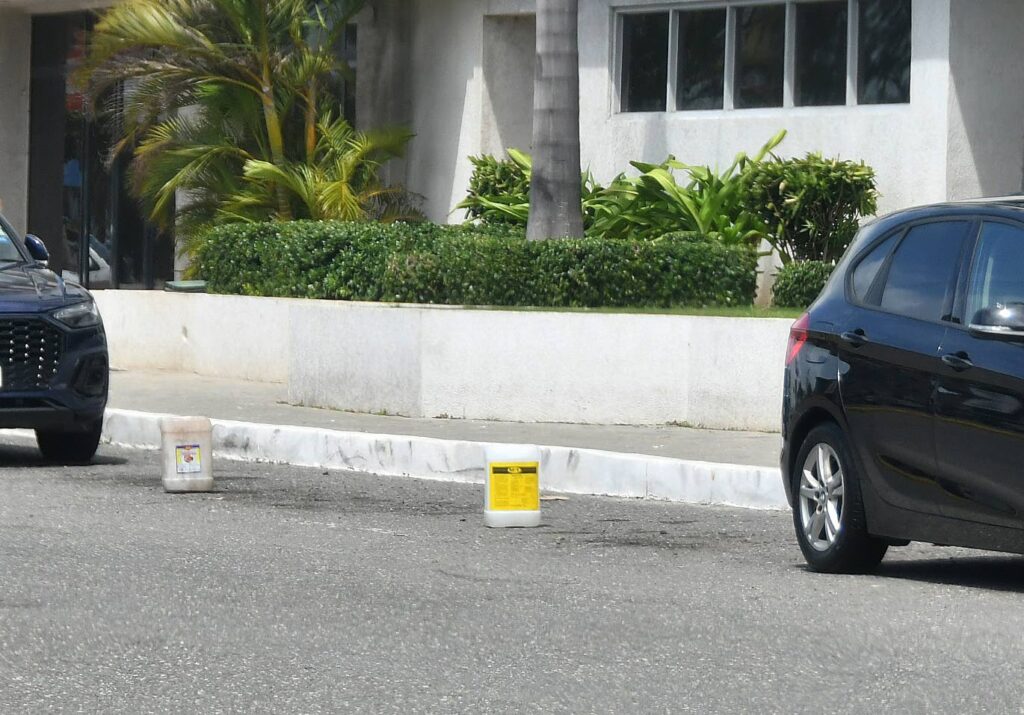
Downtown Kingston, Jamaica’s bustling central business district, has seen the rapid spread of an unregulated informal parking practice that has left many motorists frustrated, intimidated, and facing unexpected extortionate charges. An increasingly common sight for drivers navigating the area’s crowded streets is informal actors blocking public legally designated parking spaces—marked by white-painted kerbs—with buckets, plastic containers, or other debris, only moving the obstacles after motorists agree to pay a so-called “drink money” or “blessing” fee for access.
Multiple motorists who frequent the district’s major thoroughfares, including King Street, Harbour Street, Ocean Boulevard, Orange Street, and Princess Street, have shared accounts of repeated run-ins with these unauthorised attendants. One anonymous motorist told Jamaica’s Sunday Observer he has been approached for payment more than 10 times in just three months, with charges ranging as high as JMD $200 per spot. In one incident, his refusal to pay after growing fed up with the practice sparked a heated, hostile argument that left him shaken. Another motorist recounted a March encounter on Ocean Boulevard where an attendant directed him into a spot under the false pretense of offering car washing services, then chased his vehicle down the street demanding payment when he tried to leave without paying. On a separate occasion on King Street, his refusal to pay a $500 request devolved into a public screaming match.
This long-time motorist said repeated interactions with the unauthorised attendants have left him feeling violated, extorted, and constantly on edge. He expressed particular concern for less assertive drivers who may be too intimidated to refuse payment, fearing the confrontation could escalate into violence. “It is traumatic to have to go through this, and then you are basically at the peril of them if you should take actions on your own,” he explained, noting that most ordinary Jamaicans are unwilling to risk personal safety over a parking fee. He has called for urgent intervention from local law enforcement, including increased foot and mobile patrols across downtown Kingston and the immediate removal of all blocking debris from public parking spaces, pointing out that leaving buckets and old oil containers on roadways already violates Jamaica’s litter laws.
A recent on-the-ground investigation by the Sunday Observer confirmed the widespread nature of the practice. During a visit to downtown Kingston, the news team encountered multiple blocked spots along Ocean Boulevard. When the team pulled into a spot marked by a plastic container, a man in a reflective safety vest immediately removed the obstacle and allowed them to park. As the team prepared to leave and started the vehicle, the attendant reappeared, standing in front of the car on the roadway to block exit and request a “blessing” for his service. After clarifying the request was for cash to buy drinks, the team paid $100 before being allowed to leave. The team also observed another attendant demanding $500 from an unsuspecting visiting driver; when the driver refused the exorbitant rate, the attendant became visibly angry and hounded him until a lower fee was negotiated and paid. Similar operations were also observed along Darling Street outside the busy Coronation Market.
The informal attendants, however, frame their work not as extortion, but as a valuable informal service that addresses gaps left by city planning failures. Most operate in plain clothes or cheap reflective vests, appearing seemingly out of nowhere when a driver searching for a parking spot approaches the area. One attendant interviewed near Coronation Market argued that his work protects motorists from predatory tow truck operators that regularly target illegal parking zones—marked by yellow-painted kerbs—across downtown. He claimed tow truck operators often act in bad faith, towing vehicles even when drivers are still nearby, and charge exorbitant retrieval fees that far outpace the small “donation” he requests. He added that on busy market days, the limited number of official government-provided parking spots fills up almost immediately, leaving drivers with few legal options as almost all extra road space is marked no-parking. He insisted that payments are voluntary donations for his service, not mandatory demands, and that he adjusts his expectations based on what drivers can afford. “We nah do nothing wrong,” he stated.
Local law enforcement confirms that the practice has not generated many formal complaints to date, but police acknowledge that a lack of reports does not mean the problem does not exist. Superintendent Mischka Forbes, head of the Kingston Central Police division, told the Sunday Observer no recent formal complaints have been logged, but did not deny that the practice is widespread across the district.
The rise of informal unauthorised parking comes as downtown Kingston has struggled for years with a chronic shortage of legal parking that local authorities have repeatedly tried and failed to fully resolve. Both the Urban Development Corporation and the Kingston and St Andrew Municipal Corporation (KSAMC) have built public parking lots to ease congestion, but rising traffic volumes have consistently outpaced available capacity. Most recently, KSAMC has announced a series of new parking initiatives to address the crisis, including the rollout of paid parking on Orange Street, a redevelopment partnership for Gold Street with the Jamaica Stock Exchange, and plans to introduce metered parking across 32 streets spanning downtown, New Kingston, and Cross Roads. Even with these planned changes, however, downtown’s parking gap is expected to persist for years, leaving drivers vulnerable to the informal extortion schemes that have become a regular part of navigating the busy commercial district.