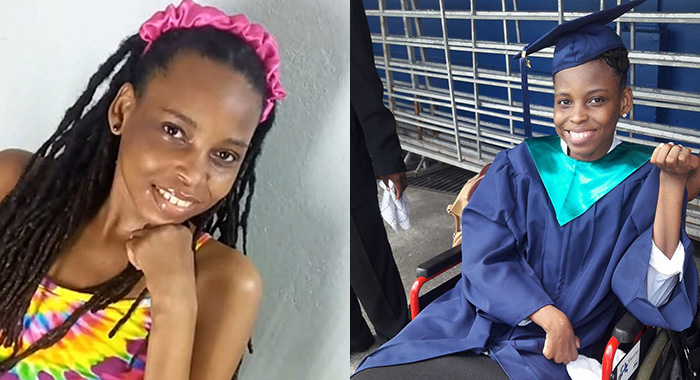
In a heartbreaking loss for communities across St. Vincent and the Grenadines, Sweet-I Robertson, a woman who turned a life-altering act of senseless gun violence into a story of relentless resilience and academic triumph, passed away Monday night following a sudden short illness. She was 33 years old.
Robertson’s journey of struggle and success began in October 2010, when the 15-year-old star athlete and fifth-form student at Petit Bordel Secondary School was struck by a stray bullet outside her school’s campus in Petit Bordel. The bullet hit her neck, leaving her permanently paralyzed from the waist down. The tragedy did not end with her injury: in 2013, Shelton Hooper, the man convicted of wounding her, was sentenced to five years in prison. Hooper and his two co-accused relatives also received 12-year sentences for a separate attempted murder, and Hooper faced additional prison time on firearms charges. In a remarkable show of grace just days after her 21st birthday in 2014, Robertson told local outlet iWitness News that she had fully forgiven the men responsible for her injury, noting that holding onto resentment had no place in her new life. “You can’t hold a grudge forever,” she said at the time.
Against all odds, Robertson refused to let her paralysis define her future. Just a year after the shooting, in 2011, she sat for the CXC O’Level examinations and passed four out of five subjects, earning the highest possible Grade 1 in mathematics. She went on to pursue higher education, graduating from St. Vincent and the Grenadines Community College in 2017 — crossing the graduation stage in her wheelchair, pushed by her older sister Racquel, an educator, to accept her certificate.
With support from Island Scholars Inc., a United States-based educational charity, Robertson continued her studies at the University of the West Indies. In July 2023, she reached a historic milestone, completing her degree program and graduating with a first-class honours Bachelor of Science in psychology. She had been preparing to launch an online counselling service to support others facing adversity when her health declined unexpectedly, leading to her death.
Local leaders and institutions stepped in to support Robertson in the years after her injury. Then-Prime Minister Ralph Gonsalves took a personal interest in her case after reading news reports of her assailants’ sentencing. Gonsalves, who used Robertson’s story to draw attention to the unregulated arms trade plaguing Caribbean communities, told a 2013 regional workshop for the UN Arms Trade Treaty that her experience was a “symbol of the creeping scourge of arms and ammunition into the most remote corners of our Caribbean civilisation”. In 2013, Gonsalves’ government arranged for Robertson to receive three months of rehabilitative treatment in Cuba, where she regained full control of her upper body, which had been left with only limited mobility in one hand before therapy. While doctors confirmed the lower half of her body was irreparably damaged, the treatment vastly improved her quality of life and restored her self-confidence. In 2014, the administration donated a custom-built, mortgage-free home to Robertson in Fitz Hughes, a gesture she said lifted a huge financial and emotional burden from her family.
Robertson’s death marks the second time in recent months that a promising young Caribbean athlete has died from complications of violence committed near their school. In March, 17-year-old top athlete Alia Mc Dowall died at Milton Cato Memorial Hospital, more than a year after she was stabbed in the throat outside Central Leeward Secondary School, where she was a student. The alleged attacker, 17-year-old Bethel High School student Doriel Duncan, has been charged with wounding with intent, granted EC$15,000 bail, and the case remains ongoing in the courts.