As Saint Kitts and Nevis grapples with one of the most severe dry seasons recorded in recent memory, government officials have advanced a targeted, infrastructure-led response to ease widespread water scarcity that has disproportionately impacted communities in and around St. Peter’s. The proactive intervention comes amid alarming rainfall deficits that have strained the island nation’s existing water distribution network, prompting urgent investments in long-term climate resilience.
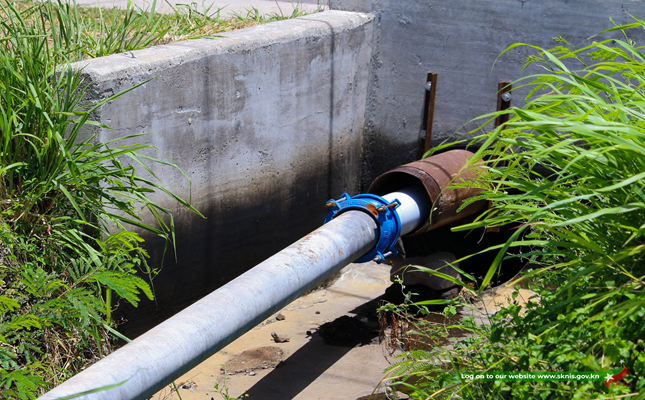
During a May 26 site visit alongside Prime Minister Dr. Terrance Drew, Cromwell Williams, a senior water engineer leading the project, confirmed that a new bulk water pipeline has been fully installed to connect a pumping station in the Basseterre Valley directly to St. Peter’s. Williams explained that the pipeline project, which has been in development for months, is designed to redirect additional potable water to the community that currently relies on strained, drought-impacted surface sources, most notably the Greenhill source that supplies upper St. Peter’s and surrounding neighborhoods.
Crews are now in the final stages of preparing the pipeline for operation: workers are reinforcing vulnerable sections of the route with concrete to stabilize the infrastructure and ensure it can withstand consistent water pressure once activated. Williams noted that after just one to two days of curing time for the concrete, the new line will go online, immediately boosting water volumes delivered to affected areas. This upgrade forms part of a broader government push to modernize water infrastructure and build systemic resilience to drought, which has become an increasingly frequent threat amid shifting global climate patterns.
Official data from the Saint Kitts and Nevis Meteorological Office underscores the severity of the current dry spell. April 2026 recorded just 1.5 inches of total rainfall, a 62.5% drop from the historical average of 4 inches for the month. “This is shaping up to be an extended dry period,” Williams noted, adding that reduced rainfall has cut output from the island’s key surface water sources, leaving many St. Peter’s residents with inconsistent access.
Prime Minister Drew framed the new pipeline as a direct outcome of the government’s intentional, forward-looking investments in climate adaptation. He explained that nearly 100 million Eastern Caribbean dollars have been allocated to water infrastructure upgrades in recent years, a move planned years ago in response to scientific projections that climate change would increase the frequency of severe drought events across the Eastern Caribbean.
“The significant drop in April rainfall is a clear consequence of shifting weather patterns driven by climate change,” Drew said during the site visit. “That is exactly why this government has prioritized heavy investment in water resilience – we knew challenges like this were coming, and we acted proactively rather than waiting for crisis.”
Drew offered assurance to St. Peter’s residents that the government remains fully committed to safeguarding consistent water access for all citizens, noting that the new pipeline will deliver meaningful, immediate relief to affected communities. Beyond infrastructure investments, the prime minister also called on residents across the federation to do their part in stretching limited water supplies through intentional conservation practices.
“Water is one of our most precious, finite resources, and I continue to encourage all our people to use water wisely and conserve as much as possible throughout this dry season,” he added.