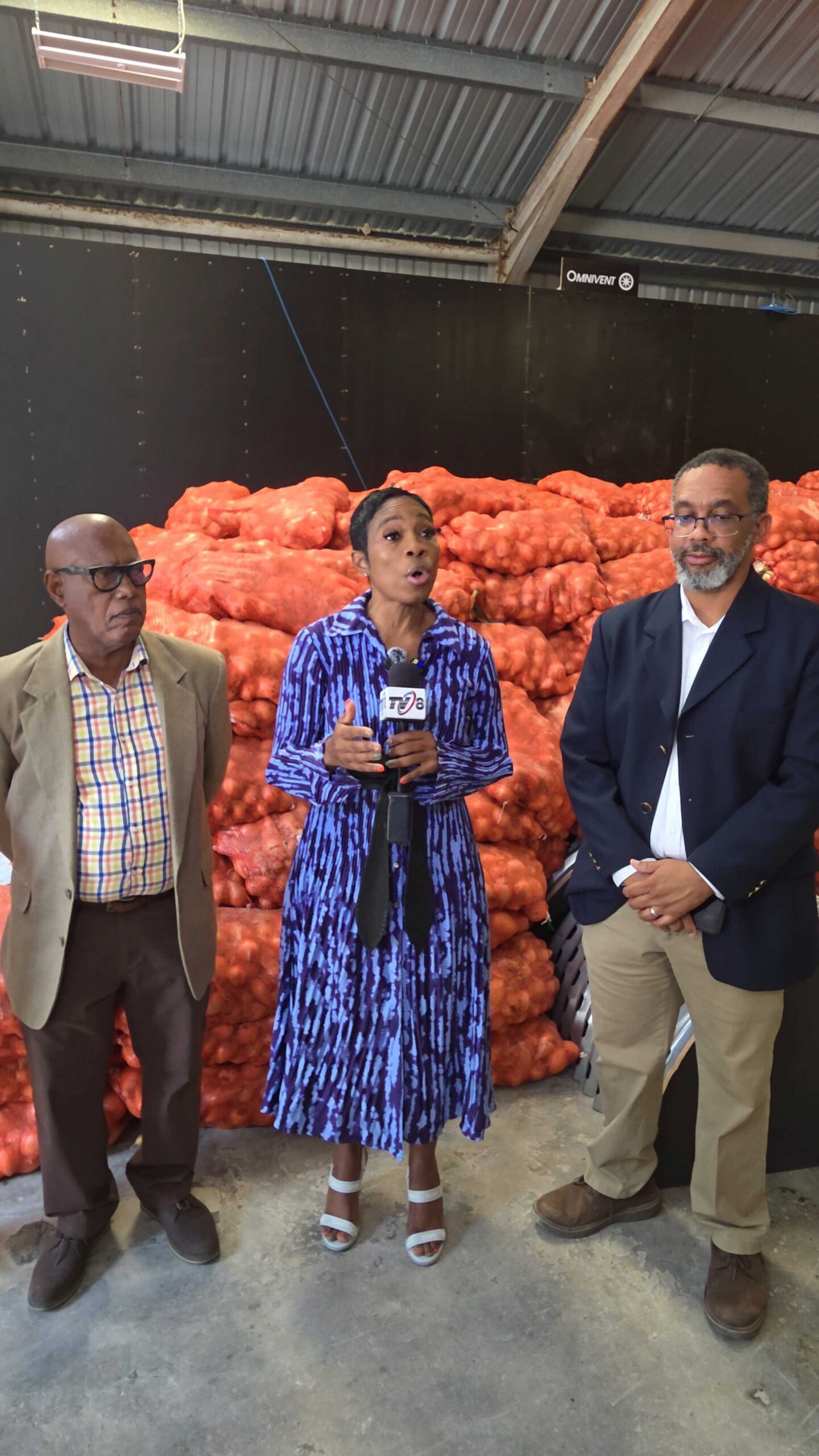
Against a backdrop of rising global food supply volatility and growing climate disruptions to local agriculture, the government of Barbados has officially kicked off a landmark agricultural initiative aimed at strengthening the island’s food security and trimming its crippling national food import bill.
Developed in partnership with the Barbados Agricultural Development and Marketing Corporation (BADMC), the Onion Escalation Project is the first major rollout of the island’s aggressive strategic crop expansion framework, a national initiative designed to buffer local farming from the erratic impacts of climate change. Under the broader national plan, 16 high-priority strategic crops have been identified to boost domestic yields and improve dietary nutrition for Barbadian citizens.
At the official launch ceremony held at BADMC’s Fairy Valley, Christ Church headquarters, Minister of Agriculture and Food Security Dr. Shantal Munroe-Knight highlighted the stark gap that currently exists between the island’s domestic onion production and total national consumption. While Barbados notched a small production uptick last year, cultivating 36 acres of land to produce roughly 483 kilograms of onions, the country remains overwhelmingly reliant on imported product to meet demand. “We are importing two million kilograms of onions. That’s what we’re doing,” Munroe-Knight emphasized, underscoring the urgency of expanding local output.
To close this massive supply gap, the BADMC’s project sets an ambitious phased target to scale onion cultivation to 100 acres over the next two years. At the core of this production expansion goal is the newly commissioned cutting-edge onion drying and chilling facility at the Fairy Valley site, a transformative infrastructure upgrade that upends long-standing barriers to year-round onion production on the island.
Historically, Barbadian onion farmers have been limited to a narrow planting window between October and November, with harvesting restricted to the February-to-May period. Thanks to the new advanced drying technology, BADMC can now extend the shelf life of locally harvested onions from just a few short weeks to multiple months. “With this new facility for onion drying, it means then that we can expand that onion production, that onion growing period… It means that we could move almost to year-round production under the BADMC crop escalation plan,” Munroe-Knight explained.
She added that the paired specialized chilling system delivers a level of production security that local farmers have never had access to before. “It gives the farmers assuredness… They will not then incur a lot of the losses that we would have had before because of the wet season and unseasonal rains. Traditional onion storage time would have been just a couple of weeks or so, now, we are looking for storage for months,” she said.
This extended storage capacity is a game-changing development for consistent local supply, allowing producers to meet consumer demand reliably regardless of seasonal weather shifts, the minister noted. She also pointed out that unseasonable and unpredictable weather, driven by accelerating climate change, has already severely disrupted traditional growing cycles. “The conditions that we had then are extremely challenged now because of climate change. Those of you who would remember, for instance, last November, we had heavy weather… because of those heavy rainfalls just last year, we’d have lost a number of acres for onions. So that climate change challenge is then significantly challenging our onion production,” Munroe-Knight said.
The new facility also addresses a long-standing point of tension between local onion producers and commercial distributors, who have historically rejected Barbadian-grown onions, claiming they were too moist and spoiled too quickly. “Well, this facility is intended to allow us to deal with that, so we need the cooperation of those distributors as well,” the minister asserted, adding that productive talks are already ongoing with local distributor associations to build buy-in for the initiative.
“We have a whole-of-country approach to this notion of how we do crop escalation, how we make sure that we can drive down our food import bill and most importantly, make food cheaper for Barbadians… and that requires all of us working together,” she said. Under the program, independent local farmers will be able to bring their harvested onions to the facility for processing and storage, with BADMC holding formal off-take contracts with participating producers to guarantee a market for their crop.
Infrastructure improvements are being paired with targeted scientific support to strengthen the program’s impact. BADMC is working hand-in-hand with the Ministry of Agriculture’s research division to introduce hardy, climate-resilient onion varieties bred to withstand wet conditions, alongside updated fungicide protocols designed to maximize overall crop yields.
Dr. Munroe-Knight extended an open invitation to the Barbadian public and the local farming community to join the effort, noting that while the project requires a measure of patience to reach full capacity, the urgent current context of food security demands rapid, strategic action. “I really want to invite Barbadians, want to invite the farming community to walk with us. It will require a level of patience, and I say patience even as the Ministry and BADMC tells me that I’m always telling them to run – because we don’t have the time. The current context requires us to be able to respond immediately, but we intend to take a strategic approach to it… and be very sure that we are able to respond to the challenges in a systematic way,” she said.
BADMC Acting Chief Executive Officer Fredrick Inniss noted that the project’s launch marks the end of three years of intensive development work, first initiated by the BADMC board of directors in 2023. Inniss paid tribute to the combined local and international expertise that brought the initiative to fruition, recognizing pioneering agricultural engineer Dr. Winston Harvey, who has collaborated with the ministry on onion production solutions since the 1980s. He also highlighted the critical technical partnership with Omnivent, a Netherlands-based global leader in specialized agricultural storage technology.
“Drying is one of the key elements of onion harvest. We have for decades been without it, but this ensures that now we actually move to a point where we actually have the capacity not just to grow the onions and send them straight to the supermarket, but if we have enough, we can actually hold them and store them for up to three months,” Inniss explained. He added that the one container-worth of onions displayed at the launch represents just one-tenth of the facility’s total storage capacity.
Inniss also recognized the hard work of internal BADMC teams, particularly the maintenance and projects units, who worked extended hours through weekends alongside the international technical team to complete the facility construction on schedule.
Beyond the onion initiative, the Ministry of Agriculture and BADMC have spent the past two months auditing internal processes, mapping available agricultural land banks, expanding agricultural extension services, and systematically addressing ongoing barriers related to soil quality and water access across all 16 targeted strategic crops, which include staple root crops such as sweet potatoes and yams. The entire initiative aligns with the broader Caribbean Community (CARICOM) “25 by 25” regional food security mandate, which sets a goal of cutting the region’s overall food import bill by 25% by 2025.