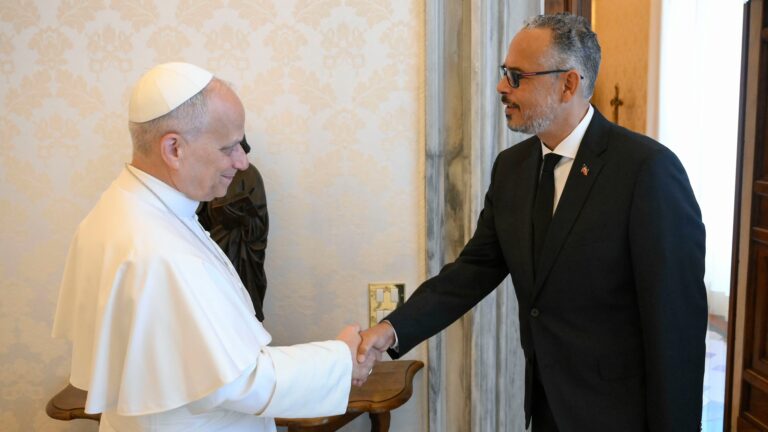
Against the backdrop of spiraling gang violence, collapsing political order and a catastrophic humanitarian emergency unfolding across Haiti, Pope Leo XIV, the supreme leader of the Roman Catholic Church, hosted Haitian Prime Minister Alix Didier Fils-Aimé for a diplomatic audience at the Vatican on Saturday.
Following the closed-door meeting with the Pope, the Haitian prime minister continued his diplomatic visit with high-level discussions with two senior Vatican officials: Cardinal Pietro Parolin, the Vatican Secretary of State, and Archbishop Paul Richard Gallagher, who serves as Secretary for Relations with States and International Organizations.
In an official briefing released after the talks, the Holy See Press Office characterized the bilateral exchanges as warm and cordial. Both participating delegations reaffirmed their commitment to the long-standing, robust ties that have connected the Caribbean nation of Haiti and the Holy See for decades.
According to the Vatican’s statement, the core of the discussions centered on the critical role the Catholic Church continues to play in Haitian society during this unprecedentedly challenging chapter in the country’s history. Beyond the Church’s ongoing work, delegations also tackled the root and ongoing dimensions of Haiti’s multifaceted crisis, including the collapsing socio-political order, the acute deterioration of humanitarian conditions, growing migration pressures and the rapidly worsening security landscape.
The official statement further underlined that international coordinated support is not just helpful, but essential, for Haiti to successfully navigate and overcome its current overlapping emergencies.
Haiti’s security breakdown has accelerated sharply in recent years, with the capital Port-au-Prince bearing the brunt of the chaos. Transnational and local armed gangs now exert complete control over large swathes of the capital and surrounding suburban and rural areas, forcing thousands of residents to flee their homes and disrupting basic access to food, water and medical care.
The unrelenting violence has upended nearly all aspects of daily Haitian life, and has weakened or damaged core state and civil society institutions—including the Catholic Church, which has long been one of the most stable service providers across the country.
Against this instability, Haiti is set to hold general elections on August 30, which will see voters select a new national president, fill all seats in the Senate and Chamber of Deputies, and elect new local mayors. The country’s last general election was held in 2016, a poll that was immediately tainted by widespread controversy over irregularities and voter suppression. After taking office following that disputed vote, former President Jovenel Moïse governed until his assassination in 2021—a shock event that plunged Haiti into even deeper political paralysis and violent unrest that continues to this day.
Earlier in 2024, Pierre-André Dumas, vice president of Haiti’s national bishops’ conference, publicly raised pointed questions about whether the upcoming August elections can deliver a credible, legitimate result. He warned that given the prevailing security and political chaos across the country, the electoral process cannot be guaranteed to be transparent or fully democratic.