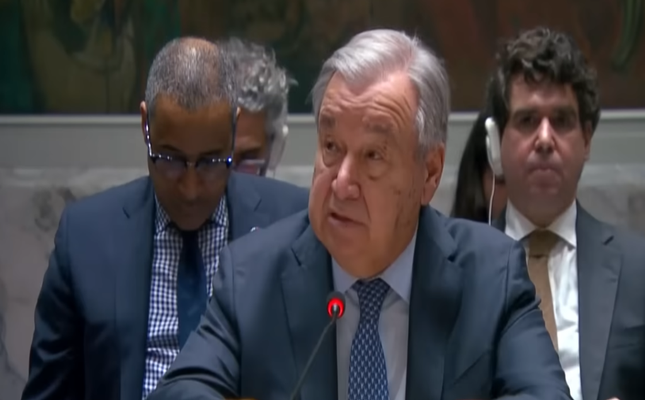
As the conflict between the United States and Iran enters its third month, United Nations Secretary-General António Guterres has issued a stark warning about the accelerating, far-reaching global economic fallout from the fighting, even as a fragile, currently holding ceasefire hangs over the region. The conflict, which first erupted in February 2026, has severely disrupted shipping activity through the Strait of Hormuz and damaged critical regional energy infrastructure, triggering dramatic spikes in global energy prices and crippling oil production across the Middle East. In press remarks to reporters outside UN Headquarters in New York, Guterres emphasized that despite the temporary pause in active combat, the overall situation remains dangerously unstable.
“I am deeply concerned about the curtailment of navigational rights and freedoms in the area of the Strait of Hormuz,” Guterres stated during the press briefing. The strategic waterway, a critical global trade chokepoint, carries approximately 20 percent of the world’s daily oil shipments, alongside large volumes of fertilizers and other essential commodities that underpin global food and manufacturing systems. Tensions between Washington and Tehran over control of and access to the strait have turned shipping disruptions into a systemic crisis, with ripple effects spreading through global energy, transportation, manufacturing, and food supply chains, Guterres explained.
The UN chief stressed that the economic pain from the conflict is already being felt in every corner of the globe. “As with every conflict, the whole of humanity is paying the price — even if a few are reaping huge profits. The pain will be felt for a long time to come,” he added. Small island developing states in the Caribbean, including Saint Kitts and Nevis and The Bahamas, are already grappling with the fallout, as skyrocketing gasoline prices have placed unprecedented financial strain on working households and small businesses alike.
To underscore the scope of the risk, Guterres outlined three distinct projected scenarios for the global economy based on how long the strait disruptions persist, noting that the negative impacts grow exponentially rather than gradually with time. In the most optimistic scenario, where the conflict ends immediately and the strait reopens to full traffic, global supply chains will still require months to fully recover. This would push global economic growth down from the projected 3.4 percent to 3.1 percent, while inflation would climb from 3.4 percent to 4.4 percent. Global merchandise trade growth would shrink from 4.7 percent recorded last year to just 2 percent, he projected, adding that the global economy, still recovering from the aftershocks of the COVID-19 pandemic and the ongoing war in Ukraine, would face further prolonged economic distress.
In the second scenario, where shipping disruptions continue through the middle of 2026, global growth would drop to 2.5 percent and inflation would rise to 5.4 percent. This outcome would push an estimated 32 million additional people into extreme poverty worldwide. Worsening fertilizer shortages would cut global crop yields, leaving another 45 million people facing acute food insecurity, and erase decades of progress in international development almost overnight, Guterres warned.
The most severe scenario forecasts that disruptions continuing through the end of 2026 would push global inflation above 6 percent and slow global growth to just 2 percent. “Immense suffering takes hold, especially among the world’s most vulnerable populations,” Guterres said. “And we confront the spectre of a global recession — with dramatic impacts on people, on the economy, and on political and social stability.”
Guterres stressed that the cumulative harm is not linear: “These consequences are not cumulative. They are exponential. The longer this vital artery is choked, the harder it will be to reverse the damage — and the higher the cost to humanity.” He added that developing nations will bear the overwhelming brunt of the crisis, as pre-existing heavy debt burdens leave them with limited fiscal space to respond to rising prices, resulting in widespread job losses, deepening poverty, and worsening hunger.
In closing, Guterres issued a clear call to all involved parties to immediately restore safe unimpeded passage through the Strait of Hormuz in full compliance with UN Security Council Resolution 2817. He also urged the full reopening of the waterway as a critical step to stabilize global commodity markets and prevent further irreversible economic damage from the ongoing conflict.