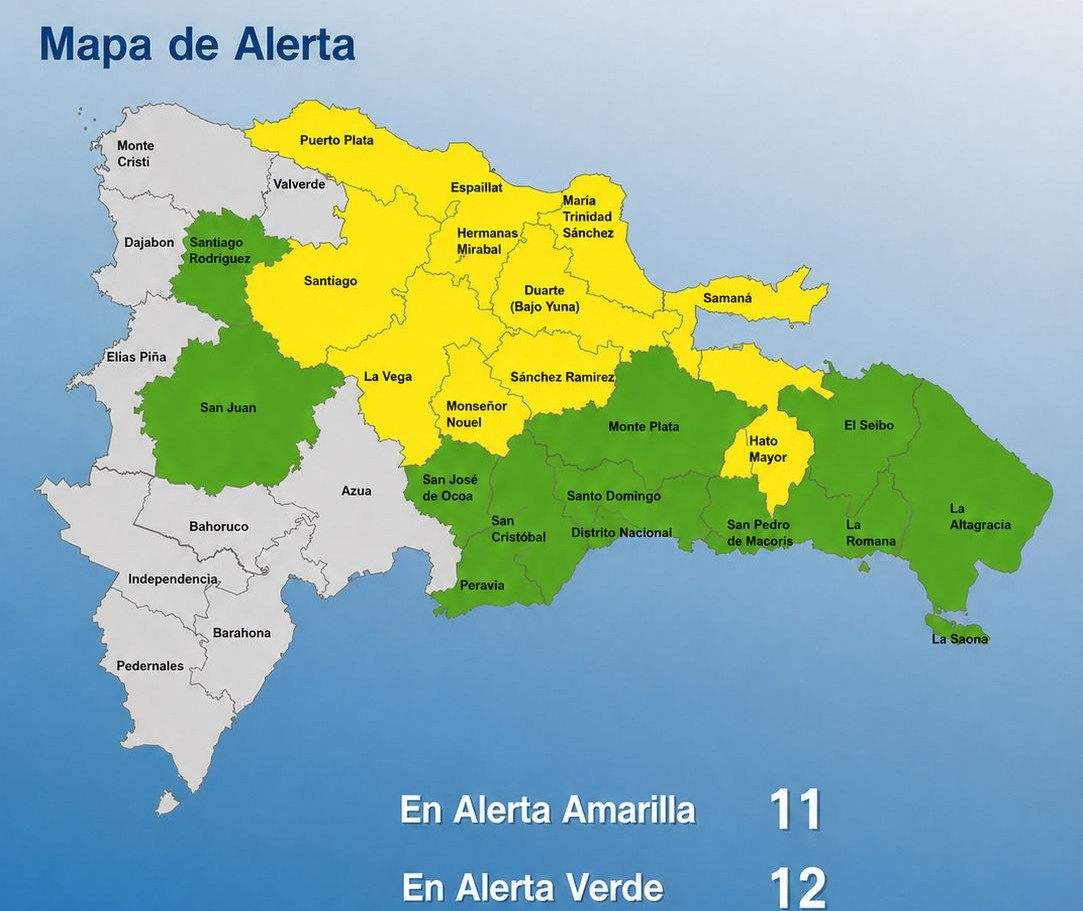
On Wednesday, the Dominican Republic’s Emergency Operations Center (COE) announced a widespread expansion of national weather warnings, ramping up precautionary measures as an unstable atmospheric pattern continues to bring hazardous conditions across the Caribbean nation. Under the updated alert framework, 11 provinces have been placed under yellow alert – the second-highest level of warning – while 12 additional provinces and the National District remain under lower-level green alert.
The 11 provinces now under elevated yellow warning status are María Trinidad Sánchez, Santiago, Duarte, Puerto Plata, Hermanas Mirabal, Hato Mayor, Monseñor Nouel, La Vega, Sánchez Ramírez, Espaillat, and Samaná. Areas retaining green alert include the major population centers of Santo Domingo, San Pedro de Macorís, La Altagracia, San Cristóbal, La Romana, Monte Plata, and the National District, the country’s capital administrative zone.
Meteorological officials from the Dominican Institute of Meteorology (Indomet) confirmed that a persistent low-pressure trough system hovering over the region will continue to drive unstable weather through the afternoon. Forecasters say the system is spurring rapid cloud development that will bring heavy downpours, severe thunderstorms, and even a chance of small hail across much of the affected areas.
The risk of extreme weather events is amplified by days of prior precipitation that have left soil across the country completely saturated. Emergency authorities have issued urgent warnings about the growing likelihood of river overflow, sudden flash floods, and widespread urban flooding in low-lying and high-risk communities.
As of Wednesday, the impact of the persistent rain has already disrupted critical public services. The National Institute of Drinking Water and Sewerage (Inapa) confirmed that 12 regional aqueducts have been taken out of service by flood damage or operational disruptions, cutting off water access to more than 205,000 residential and commercial users across the affected regions.
In a public advisory, the COE has urged all residents in at-risk zones to strictly follow official safety guidance. The agency specifically warned communities against attempting to cross swollen rivers or flooded streams, and reminded people living in flood-prone areas to remain ready to evacuate if conditions worsen.