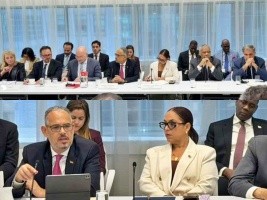
In a high-profile gathering on the margins of a UN Security Council session focused on the UN Secretary-General’s quarterly report on the UN Integrated Office in Haiti (BINUH), Haiti’s top diplomatic and governmental leaders have made an urgent appeal for stepped-up global support to address the country’s escalating challenges. Held on Thursday, April 23, 2026, the side event was co-hosted by Haiti and Canada through their permanent missions to the United Nations, drawing an unprecedented cross-section of global stakeholders to coordinate action on Haiti’s crisis.
More than 60 UN member states took part in the event, with major global and regional powers including the United States, France, Germany, China, Brazil, Kenya, El Salvador, and the Dominican Republic sending representatives. Multiple leading international institutions also joined the deliberations, alongside senior officials heading key missions in Haiti. Attendees included Jack Christofides, the designated Special Representative for the Gangs Suppression Force (GSF), UNICEF Executive Director Catherine Russell, and Carlos G. Ruiz Massieu, the UN Secretary-General’s Special Representative for Haiti.
The core mandate of the gathering was to tighten coordination across three critical groups: UN Security Council members, nations contributing personnel and resources to the Gangs Suppression Force (GSF), and all international and regional partners that collaborate directly with Haitian state institutions. With the Caribbean nation grappling with prolonged gang violence, institutional instability, and stalled democratic progress, the event served as a platform for Haiti’s leadership to lay out its most pressing priorities for global support.
In his keynote address to attendees, Haitian Prime Minister Alix Didier Fils-Aimé pressed the international community to ramp up its collective mobilization to back the Haitian government’s two core priorities: restoring national security and advancing the restart of the country’s electoral process. The Prime Minister underlined the critical urgency of fully deploying the GSF across Haiti to counter rampant gang activity, while also stressing that enhanced international backing is required to advance key institutional reforms. Among the most critical of these reforms, he highlighted strengthening the national justice sector and expanding efforts to combat systemic impunity for violence and corruption.
The gathering marks a key moment in global diplomatic efforts to align behind Haiti’s recovery, as international stakeholders continue to work through the UN framework to coordinate a coordinated response to the country’s deepening crisis.