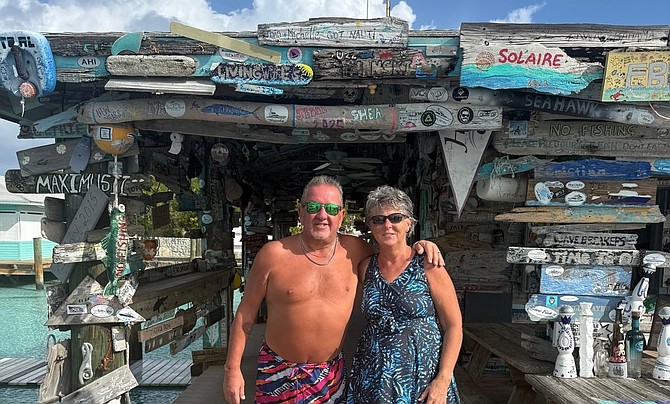
For a couple married more than 30 years, a three-day birthday getaway to the idyllic Staniel Cay in the Bahamas was meant to be a quiet celebration of Gerry Martell’s 70th year. What unfolded on that trip in January would leave Ann Martell, Gerry’s wife from Ontario, Canada, grappling with unprocessed trauma that has required ongoing therapy and daily medication, as she continues fighting for answers months after her husband’s sudden death.
The tragedy struck on the second day of the vacation, as the couple joined a boat tour and swam near a local cave. Ann Martell watched in horror as her husband fell into distress, clinging to a nearby orange buoy thrown by other people on the water. His final words to her were, “help me, I’m dying,” before he lost consciousness.
The captain of a nearby yacht quickly launched a small dinghy to pull Gerry from the water and rushed him back to shore as fast as possible. During the desperate voyage back, Martell says her husband suffered violent seizures, an episode she now suspects was triggered by a brain bleed related to the underlying heart condition that would later be named as his cause of death. Once on shore, a doctor who happened to be staying at the marina performed cardiopulmonary resuscitation, but the efforts were too late—Gerry could not be revived, and Ann was told her husband had passed away minutes later.
If the sudden loss was not devastating enough, Ann says the mishandling and callous treatment that followed the death compounded her trauma beyond measure. After Gerry’s body was moved to a medical trailer on the island, Ann was immediately ordered to gather her belongings, withdraw cash, and prepare to leave Staniel Cay before sunset, because the small island had no dedicated cold storage facility to hold a deceased person.
“I was given almost no time to call my family, to sit with my husband, to say a final goodbye,” Martell shared in an exclusive interview with Tribune. “All I remember is people yelling at me nonstop. First they screamed I had to come up with $60,000 or Medevac wouldn’t come get the body, then the next minute they changed it to $6,000, saying we had to get him out of there immediately because we had nowhere to put him. They told me to grab my husband’s credit card and go get the cash right now.”
The unprofessional, insensitive treatment extended to the responding law enforcement officer on scene, Martell says. The officer hounded her for an official statement immediately after Gerry’s death, following her around the medical trailer and repeating the demand even as she begged for space to process what had just happened. “I was getting so frustrated,” she recalled. “I just kept asking him to leave me alone, but he wouldn’t listen to anything I said.”
Breaking the news of her father’s death to the couple’s adult children was equally devastating. Their daughter, who resides in Egypt, collapsed when she received the devastating call.
The most distressing part of the entire ordeal, Ann says, came when it was time to transport Gerry’s body off the island to Nassau’s New Providence. She watched as staff loaded his body into the plane wrapped in nothing but heavy green garbage bags sealed with red tape, and then she was forced to sit through the entire flight with the wrapped body positioned directly at her feet. No staff member warned her ahead of time how the body would be transported, she says, nor did anyone offer to move her to another seat to avoid the dehumanizing experience.
“How is it possible that no one had even a little bit of compassion to tell me what was going to happen, to treat my husband like a human being rather than trash?” she asked. Later, a nurse explained to Ann that the garbage bags were only an outer covering, placed over a clear standard body bag because Gerry’s body was wet when it was retrieved from the water. Ann rejects that explanation, pointing out that her husband did not drown, and was only in the water for a matter of minutes before he was pulled out.
When they arrived in New Providence, Ann waited more than an hour for a mortician to arrive, only to learn he had been delayed by a prior funeral commitment. She and her family then waited for multiple additional hours before they were allowed to formally identify Gerry’s body.
Though both the Bahamian Coroner and an attending pathologist expressed concern over the handling of Gerry’s body and the circumstances of the aftermath, and pledged to launch a formal investigation into the incident, Ann and her family have yet to receive any updates or official answers more than six months later. Ann has formally requested a full copy of the police report into her husband’s death, to clarify the official timeline of events and identify the doctor who performed CPR—she says she still does not even know his name. She has shared her correspondence with Commissioner of Police Shanta Knowles with the Tribune, and the commissioner had not responded to requests for comment as of press time.
Gerry Martell’s cause of death was later confirmed by doctors to be a heart blockage. His body was cremated in the Bahamas, and his ashes were returned to Ann and their family in Canada. In the months since, Ann has relied on close friends to get through each day, saying the entire experience has left her disgusted, heartbroken, and deeply angry at how the situation was handled on Staniel Cay. “The way they treated my husband and me that day was completely reprehensible,” she said. “He was a human being, and he was treated with no dignity, no respect at all. I just want answers, and I want people to know what happened to us.”