For weeks, communities across St Joseph have struggled with intermittent, unreliable water access that has upended daily life, leaving families scrambling to secure basic supplies even as local leaders and national officials move forward with a landmark $100 million infrastructure overhaul designed to fix the island’s long-standing water woes permanently.
While attending the International Monetary Fund and World Bank Spring Meetings in Washington D.C. last Thursday, Prime Minister Mia Mottley formalized a $160 million Barbadian dollar (equivalent to US$80 million) financing agreement with the Inter-American Development Bank to fund full modernization of St Joseph’s aging water network. The long-planned project targets the replacement of corroded, decades-old water mains that have been the root cause of repeated supply disruptions across the region.
Despite broad public support for the transformative initiative, affected residents are sounding the alarm that immediate relief remains out of reach for hundreds of households that have gone weeks without consistent running water. Many question how long they will have to endure unsafe, inconvenient conditions before the upgrades deliver tangible change.
Bernard Brown, a long-term resident of Lower Parks, told reporters that his household has gone eight full weeks without proper running water. “I recognize the Prime Minister is working to solve this problem long-term, but right now we need water today,” Brown said. “How many more weeks are we going to go without before anything changes?”
Brown outlined the daily struggles his community faces, noting that water trucks dispatched to fill gaps in service rarely arrive at convenient times. “Sometimes you don’t even see the water trucks during the day; they roll in the middle of the night when everyone is asleep. We have a regional water tank, but it sits at the top of the hill, and we live downhill – nothing ever reaches us.”
Like many residents, Brown pushed back on the requirement to pay full water bills despite receiving no consistent service. “If we could just get water two or three times a week, we could manage – wash clothes, flush toilets, take care of our kids. School starts next week, and people can’t even get their children ready. It’s unfair that we’re still expected to pay for a service we aren’t getting, when we’re already paying out of pocket for alternative laundry or to haul water ourselves,” he said.
Ingrid Knight, a resident of the Dark Hole neighborhood, described her experience as cautiously optimistic about the future project but stressed that current conditions are untenable for her large household. “The proof will be in the pudding – if this project delivers uninterrupted water, we’ll all be the first to celebrate it,” Knight said. For now, though, she added, water only trickles through for a few short hours in the early morning before cutting out again. “Last week, I got up at 3 a.m. when I noticed it was on, filled a few bottles, and by 7 a.m. it was gone again.”
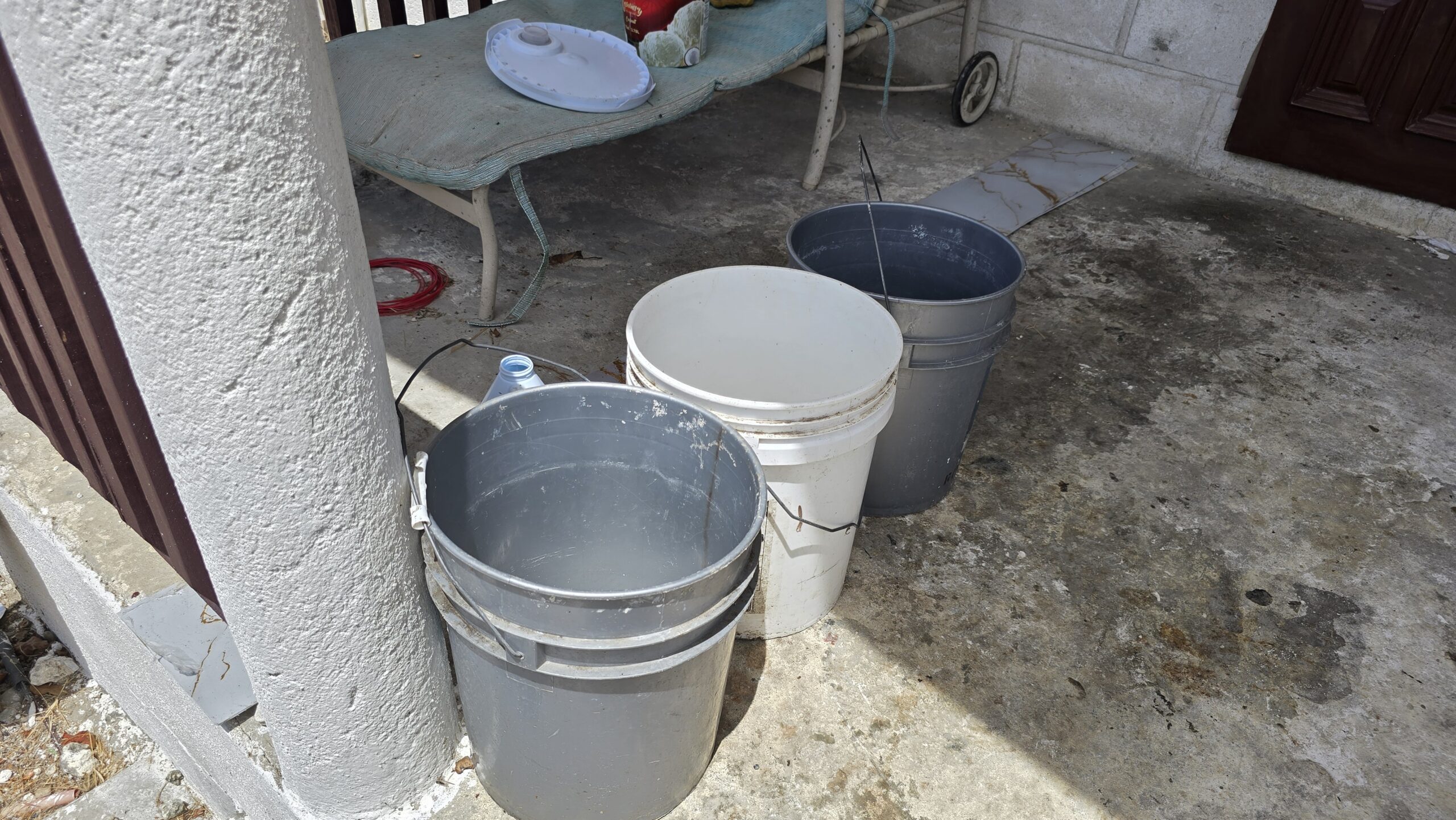
With four children and a grandson living in her home, Knight says she has to make weekly trips to secure water from an outside source. “I have a car, so I pack all my buckets and bottles and drive up to Coconut Grove, where there’s a public standpipe that always runs. Sometimes we even bathe and wash clothes up there before coming back. The water tanker rarely comes – my daughter called multiple times last week, and it only showed up once.”
Residents of upper Parks Road, also known as Saddle Back, report similar struggles, with some going up to three weeks without consistent service and water trucks arriving sporadically with no advance warning. Kimberley Yearwood, a beekeeper and landscaper who has been waiting days with empty buckets and drums for a tanker delivery, shared her experience from last week: “The Water Authority showed up at 11 p.m. By the time the driver got to my house, he only had enough water for four buckets, and all my neighbors down the road got nothing.”
Yearwood added that many residents miss deliveries entirely because the trucks do not sound an alert to notify the community – people have to wait outside constantly just to catch a delivery when it arrives. She also raised public health concerns about a nearby storage tank that is regularly refilled but has unknown maintenance and cleaning schedules. She echoed other residents’ frustration that repair work in upper sections of the community has not translated to improved service for Lower Parks and Fruitful Hill, where outages are most severe.
Another resident, who only gave his name as Blenman, criticized the utility for a lack of backup infrastructure and transparent communication with affected communities. “If one pump breaks down, you have to have a backup system ready to go – there’s just no excuse for leaving people without water for this long,” he said. “It feels like we aren’t even on the map. No one updates us on what’s happening, no one tells us when to expect service back. I don’t think anyone should be paying their water bills right now under these conditions.”
Local Member of Parliament Ryan Brathwaite, who is himself a St Joseph resident affected by the outages, confirmed that he has repeatedly called on the Barbados Water Authority (BWA) to increase the frequency of tanker deliveries to impacted neighborhoods.
In response to public outcry, BWA officials confirmed that they have repaired roughly 40 burst mains, leaks, and faulty hydrants across St Joseph in the first three months of 2024, all stemming from the aging infrastructure the new project will replace. In a late Friday statement, the authority said it is deploying additional field teams to conduct full inspections of affected areas, identify unreported leaks, and restore normal service as quickly as possible. “Field teams continue to actively conduct service checks in the impacted areas to identify the root causes of the decreased levels and supply interruptions. To date, a number of leaks have been detected and repaired,” the statement read.