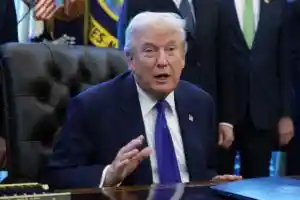
Two parallel diplomatic breakthroughs have brought cautious new momentum to Middle East peace efforts this week, even as ongoing conflict and deep policy disagreements underscore the extreme fragility of efforts to stabilize a region roiled by more than six weeks of full-scale war. US President Donald Trump announced Tuesday that a new round of bilateral peace negotiations between the United States and Iran could convene as early as this week in Pakistan, just one day after he claimed that unnamed Iranian officials had reached out to his administration seeking a negotiated settlement.
Simultaneously, Israeli and Lebanese officials confirmed an agreement to launch the first direct high-level negotiations between the two longtime formal adversaries since 1993, following a mediated meeting in Washington hosted by US Secretary of State Marco Rubio. This rare opening has been immediately met with fierce pushback from Lebanese militant group Hezbollah, which launched a rocket attack targeting more than a dozen northern Israeli communities precisely as the diplomatic meeting kicked off in Washington.
The United States has emerged as the primary driver of both diplomatic tracks, driven by growing fears that ongoing open conflict between Israel and Hezbollah could unravel the fragile two-week ceasefire already in place between Washington and Tehran, which followed an initial round of inconclusive talks in Pakistan earlier this month. Lebanon was dragged into the broader regional conflict after Hezbollah launched attacks against Israel in support of its core ally Iran, triggering large-scale Israeli ground incursions and airstrikes that have left more than 2,000 people dead and forced over 1 million Lebanese residents to flee their homes.
Rubio, who mediated the initial meeting between Israeli ambassador Yechiel Leiter and Lebanese envoy Nada Hamadeh Moawad, framed the gathering as an unprecedented opening for decades-long tensions. “This is a historic opportunity,” Rubio stated during opening remarks, acknowledging that “decades of history” hang over the fragile negotiating process. Lebanese President Joseph Aoun added that he hoped the talks would “mark the beginning of the end of the suffering of the Lebanese people.”
A US State Department spokesperson characterized the initial discussions as “productive,” confirming that “All sides agreed to launch direct negotiations at a mutually agreed time and venue.” While Leiter noted that both nations shared the core goal of removing Hezbollah’s armed influence from southern Lebanon, Moawad described the meeting as “constructive” while emphasizing that she had pushed aggressively for an immediate ceasefire. Israel, which currently maintains military control over parts of southern Lebanon, has rejected any ceasefire that leaves Hezbollah’s military infrastructure intact, arguing the group remains the single greatest barrier to long-term regional stability.
Parallel to the Israeli-Lebanese track, the Trump administration has simultaneously ramped up economic and military pressure on Iran to advance its negotiating position, announcing a full naval blockade covering “vessels of all nations entering or departing Iranian ports and coastal areas,” per a statement from US Central Command. As of Tuesday, CENTCOM claimed that no vessels had transits through the relevant area and six ships had complied with orders to turn back, though public maritime tracking data indicated that several vessels that had docked at Iranian ports had crossed the blockade zone since it was imposed.
Iran’s military command has decried the blockade as an act of state-sponsored piracy, issuing a stark warning that if Tehran’s harbor security is threatened, “no port in the Persian Gulf and the Arabian Sea will be safe.” Regional security analysts note that the blockade serves two core strategic goals for the White House: cutting off critical oil export revenue for Tehran, and pressuring Beijing—Tehran’s largest crude oil customer—to push Iranian leadership to reopen the Strait of Hormuz, a critical global oil chokepoint. China has already labeled the blockade “dangerous and irresponsible” after Trump issued an explicit threat to sink any vessel that attempts to enter or leave Iranian ports in violation of the order.
Despite the rising tensions, the temporary ceasefire between the US and Iran agreed last Wednesday remains in place. Global financial markets reacted positively to renewed hopes for a negotiated end to the conflict, with stock indices climbing and international crude oil prices retreating. By Tuesday, Brent North Sea Crude traded at $94.79 per barrel, while West Texas Intermediate fell to $91.28. The US Treasury also confirmed it will not renew a temporary sanctions waiver for Iranian oil, which was implemented earlier to offset war-related supply disruptions to global energy markets.
Hezbollah leader Naim Qassem reiterated his hardline position ahead of the Washington meeting, calling for the negotiations to be canceled and vowing to continue armed resistance against Israel. The international community has largely welcomed the diplomatic openings, with foreign ministers from 17 nations including Britain and France urging all parties to seize the moment to secure lasting regional security. UN Secretary-General Antonio Guterres has emphasized that “there is no military solution” to the conflict, adding that lasting peace requires “persistent engagement and political will” and that “Serious negotiations must resume.”
At the center of the US-Iran negotiating impasse remains the long-running dispute over Tehran’s nuclear program. Pakistani diplomatic sources have confirmed to AFP that Islamabad continues to work behind the scenes to convene a second round of US-Iran talks. Trump has repeatedly stated that any final deal must permanently block Iran from acquiring a nuclear weapon, a core justification for his administration’s launch of the war earlier on the basis of claims Tehran is actively pursuing an atomic bomb—allegations Iran has repeatedly denied.
According to reports from The New York Times, US negotiators offered a proposal during the first round of talks that would require Iran to suspend all uranium enrichment activities for 20 years, a demand Tehran has rejected. In response, Iran put forward a counter-offer to suspend nuclear enrichment for five years, an offer US officials have dismissed as insufficient. International diplomatic efforts have accelerated in recent days, with Russian Foreign Minister Sergei Lavrov meeting with his Chinese counterpart in Beijing just hours after holding talks with Iran’s top diplomat. Moscow has already tabled a proposal to securely store Iran’s enriched uranium as part of any final nuclear deal, adding another layer of international involvement to the ongoing negotiations.