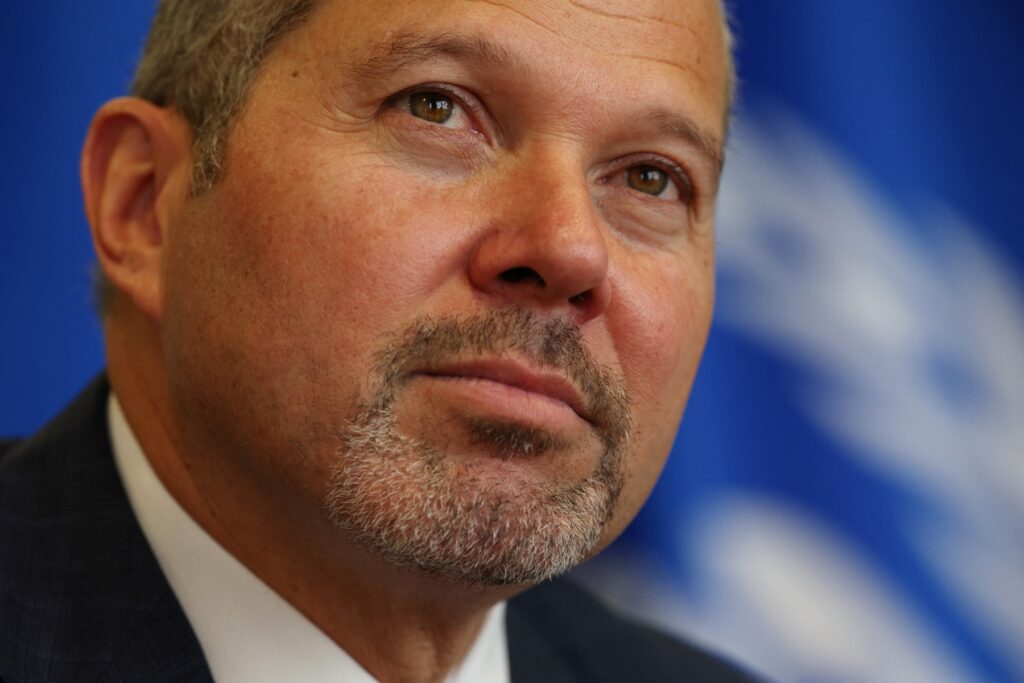
LONDON (AFP) – Six weeks into open conflict between the United States, Israel and Iran that has choked off one of the world’s most critical energy and trade chokepoints, the top leader of the United Nations’ global maritime regulatory body has issued a clear legal rebuke: no nation has the authority under international law to block commercial shipping through the Strait of Hormuz.
International Maritime Organization (IMO) Secretary-General Arsenio Dominguez laid out the organization’s position during a press briefing in London, as the waterway that connects the Persian Gulf to the Arabian Sea — through which roughly 20% of the world’s daily oil consumption and a large share of global liquefied natural gas trade transits — remained largely paralyzed by escalating military tensions. The conflict erupted February 28 after joint strikes by U.S. and Israeli forces against Iranian targets, after which Tehran moved to restrict access across the strait.
In remarks that clarified the IMO’s stance on the mounting crisis, Dominguez emphasized that binding international law upholds the right of innocent passage and guarantees unimpeded freedom of navigation for all commercial vessels through international straits used for global transit. No sovereign state, he said, is legally permitted to revoke these fundamental protections.
To date, Iranian authorities have only allowed a small, carefully vetted trickle of vessels to pass through a narrow corridor along its territorial coast. Multiple independent reports have documented that Iranian officials have demanded unofficial payments from vessel operators to grant passage, a practice Dominguez says has no standing under international rules.
“Charging a toll for navigation through an international strait directly violates the United Nations Convention on the Law of the Sea and long-standing customary international maritime law,” Dominguez said. “Beyond being illegal, this move sets an extraordinarily dangerous precedent that could upend decades of established norms governing global trade routes.”
The situation has been further complicated by the United States’ recent vow to implement its own full blockade of all Iranian ports along and near the strait, set to begin this week. Dominguez noted that this additional U.S. military move does nothing to ease the already strained situation for global shipping. He added, however, that the practical impact of the U.S. blockade would likely be minimal, given how sharply traffic has already dropped since the conflict began.
“With already just a handful of ships managing to complete transits each week, an additional blockade will not exacerbate the crisis to any significant degree that would shift the current status quo,” he explained.
Dominguez concluded by stressing that the only sustainable path forward to resolving the crisis and restoring normal commercial shipping operations through the strait is immediate de-escalation between all conflict parties. Only through lowering tensions can global trade through this vital route return to its pre-crisis levels, he said.