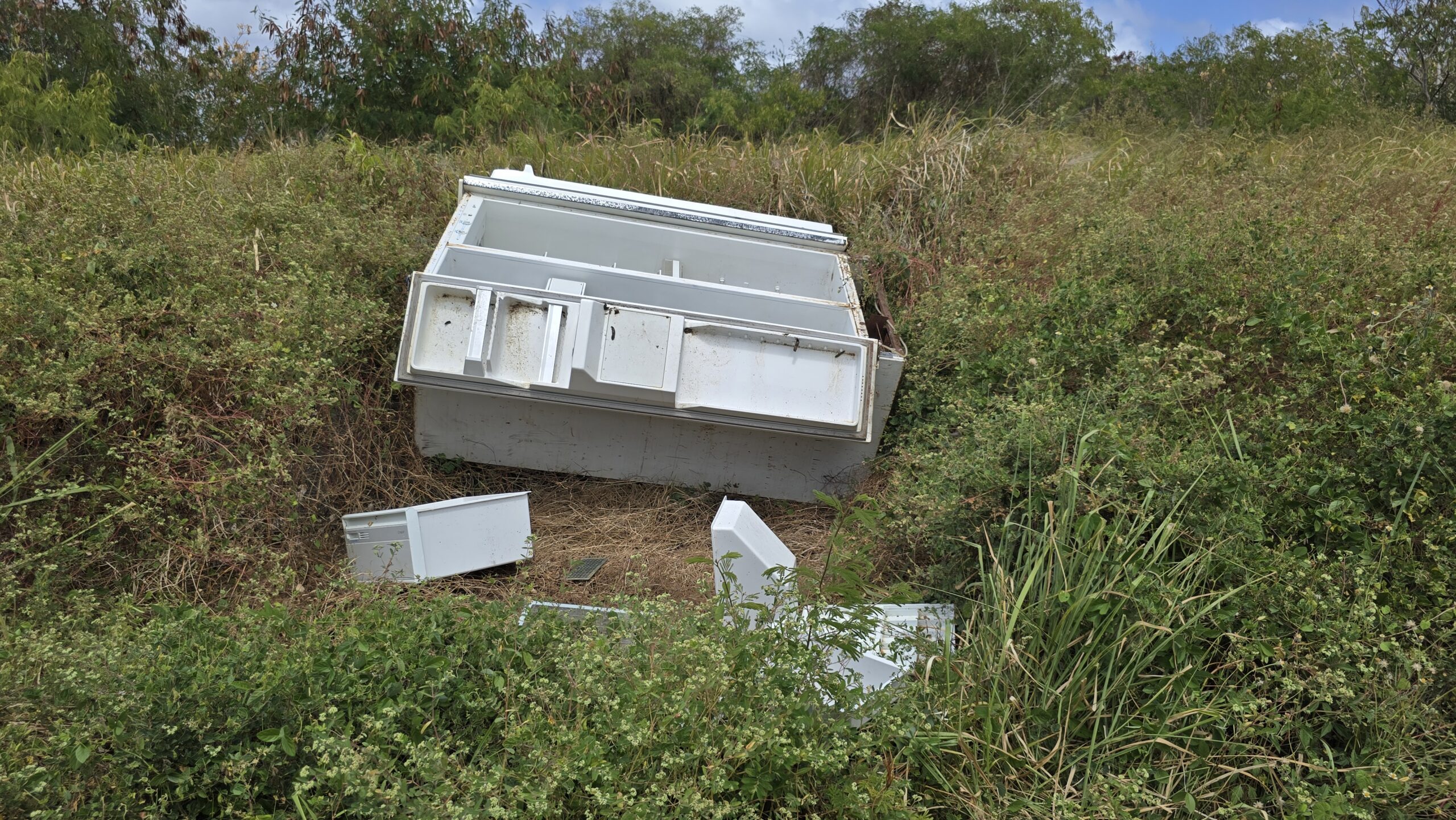
In the quiet rural community of Bayleys Plantation Road in St Philip, Barbados, a decades-long public health crisis has finally been brought to light by frustrated local residents, who say repeated illegal dumping of waste — including decaying animal carcasses and discarded household appliances — has upended their daily lives and damaged local livelihoods.
Local farmer Alvin Wilson, one of the most vocal critics of the ongoing problem, recently spoke out against those responsible for the reckless dumping, describing the toll the unregulated waste has taken on the area’s residents and farms. When a reporter from Barbados TODAY visited the community this Friday, Wilson led a tour of multiple dumping sites along the main highway, where discarded old refrigerators, stoves and other large appliances sit abandoned alongside piles of general household rubbish.
The most alarming find, however, lies on the only access road leading to Wilson’s home, his farm, and the properties of his neighbors: a large flour bag stuffed full of dead chickens, swarming with flies and emitting a putrid stench that hangs in the air along the entire stretch of road. Wilson explained that this type of dumping is far from an isolated incident. For years, the area has been a regular dumping ground for unwanted waste, ranging from dead farm animals to broken home appliances.
“Mostly it’s dead animals we find here — chickens, sometimes pigs, sometimes sheep,” he said. “And it’s not just animals. You also get old fridges, old stoves, all kinds of rubbish. This has been going on for years now.” The stench from decomposing animal carcasses is so strong that it has immediate health impacts for anyone passing by. Wilson told reporters he already had a splitting headache on the day of the visit, brought on by direct exposure to the foul odor coming from the latest dump site.
This most recent batch of dead chickens was dumped earlier this week, Wilson said — and brazenly, in the middle of the day, not under cover of darkness that dumpers usually rely on. “I’d say it was Tuesday afternoon this was dumped here, not even at night. It was broad daylight when they left that batch of dead chickens right here,” he explained, gesturing to the fly-blown bag behind him.
What makes the situation particularly untenable for local residents is that this dumping is happening on the only road connecting their homes and farms to the rest of the island. Every single person who lives or works in the area has to pass the dumping sites multiple times a day, no exceptions. “You have to pass there to get home, and you have to pass there to get to the farmlands — this entire area is surrounded by agricultural land,” Wilson said.
The stretch of road from Mapps to Golden Grove has become the preferred dumping ground for perpetrators, he explained, because it is poorly lit at night, making it easy for truck drivers and even local homeowners to drop off unwanted waste unseen. But what worries Wilson most is that dumpers have become so emboldened by the lack of enforcement that they are now willing to dump in broad daylight, a sign the problem is growing worse rather than improving. “Something needs to be done about these culprits,” he emphasized.
Longtime resident Wilbert Gollop, who has lived in the area for 16 years, confirmed that the illegal dumping has been a persistent problem throughout his time in the community. He recalled one Sunday after returning home from worship at the Kingdom Hall, he found a large, dead ram sheep bloated and stinking right on the roadside just a short distance from where he stood speaking to reporters.
Gollop also had his own run-in with the bag of dead chickens, discovering it shortly after dumpers left it on the road. He said that in addition to dumping dead animals, some irresponsible actors have even released live chickens onto the roadside, where the animals are left to starve to death before becoming part of the waste problem. “I’ve never seen anything like it. They release dozens of live chickens here, and with no one to feed them, they all die along the road,” Gollop said. “It’s pigs, it’s dogs, mainly chickens — they just come dump whenever they feel like it, no regard for anyone who lives here. It’s ridiculous. You wouldn’t want this dumped outside your door, so why do it to us?”
Unlike waste handled by official authorities, residents are forced to clean up the mess dumpers leave behind, Gollop explained. When the dead ram was dumped near his home, it was so close that flies from the carcass began moving into his house, leaving him no choice but to handle the disposal himself. “I had to drag it out to the pasture, get wood and tires, and burn it myself. That should never have been my job,” he said. “If you’re raising chickens and making money from it, why should local residents be stuck with the cost and work of disposing your waste? Why do you get to dump it next to people’s homes and on our road?”
For Wilson, the problem is not just a public health nuisance — it is an active threat to his livelihood. His farm, which grows pumpkins, butternut squash, watermelon, okra and cucumbers, relies on customers being able to access his property to buy produce. Now, many customers refuse to travel through the foul-smelling, partially blocked road, and Wilson is losing critical revenue as a result.
“This year, customers aren’t coming back through here because it stinks, and the road is blocked,” he said. “I’m losing revenue right now. I’ve had to start delivering all my produce to customers myself, which takes time I don’t have — and I don’t get compensated for that extra time and cost. What’s worse, some customers tell me they just won’t come at all anymore, so I end up stuck with produce I can’t sell. Sometimes sales get delayed for days just because we can’t get products out easily.”
Wilson said he has already reached out to the Sanitation Service Authority and the Ministry of Health to report the ongoing problem, and during Barbados TODAY’s visit to the area, reporters observed health inspectors conducting an on-site assessment of the dumping sites.
In closing, Wilson issued a direct plea to those responsible for the dumping to change their behavior immediately. “Stop the dumping,” he urged. “If you have dead animals to dispose of, call the relevant authorities and let them handle the waste properly. At the end of the day, this is affecting real people’s lives. Don’t put us through something you would never want to deal with yourself.”