The concept of “culture” is far from an immutable moral foundation. It can be twisted, reinterpreted, and shaped to fit the selfish needs of those in power, depending on how deeply rooted a society’s moral emptiness and hypocrisy run. Nowhere is this double standard more obvious than when comparing two Caribbean approaches to whales: one rooted in scientific care and collective protection, and another that defends cruel killing as cultural tradition.
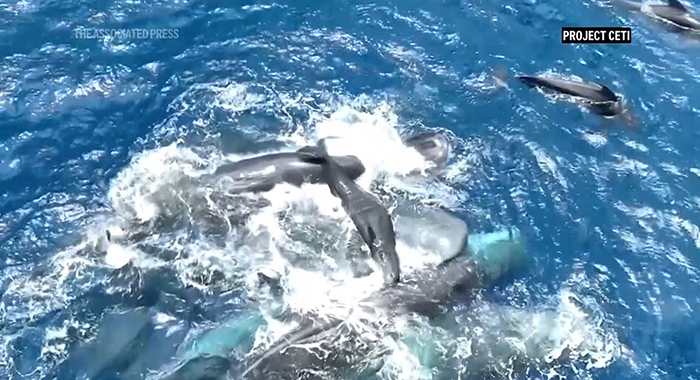
Last year, a team of marine biologists published groundbreaking findings from a rare, fully documented sperm whale birth they witnessed off the coast of Dominica in 2023. The expedition had originally set out to tag sperm whales to track their migratory patterns and complex acoustic communication systems, when researchers encountered a cluster of 11 sperm whales gathered unusually tightly at the ocean surface. Deploying camera drones to investigate the odd behavior, the team captured the entire birth of a 12th whale: the first complete documentation of a sperm whale birth in human history.
Over two years of frame-by-frame analysis of the drone footage, researchers made remarkable discoveries about the complex social bonds of sperm whale communities. The mother, a well-documented individual named Rounder, belongs to Unit A, a social group made up of two unrelated whale families that regularly return to the waters off Dominica. When Rounder’s calf was born, it was completely helpless, unable to swim on its own and at risk of sinking if left unsupported. For the first three hours of the newborn’s life, every member of Unit A took turns holding the calf afloat, pressing their bodies close together to form a living raft beneath it. While Rounder and her half-sister Aurora led the rescue effort, the group also included a whale from the unrelated second family, Ariel, as well as Rounder’s 15-year-old half-brother Allan, who traveled to the site specifically to attend the birth. The extraordinary cooperative care displayed by the entire social group left even seasoned researchers deeply moved.
This story of intergenerational whale solidarity stands in brutal contrast to the cultural practice of unregulated whaling in nearby St. Vincent and the Grenadines, local commentator Patrick Ferrari argues. If the same pod of sperm whales had gathered near St. Vincent and the Grenadines instead of Dominica, Ferrari says, Rounder and her newborn calf would not have been celebrated — they would have been hunted down for meat. While local whalers primarily target humpback whales, he notes, they do not turn away easy prey like sperm whales or vulnerable calves.
Ferrari pulls no punches describing the brutal process of traditional whaling in St. Vincent and the Grenadines: Hunters in small boats drive a heavy iron harpoon into the whale’s body, attached to buoys that tire the animal out over hours of agonizing struggle. Once the whale is too exhausted to fight back, hunters use lances to stab deep into its heart and lungs. The animal dies a slow, torturous death from blood loss, organ damage, and extreme pain, before its body is towed back to shore where the kill is celebrated as a community event. Local defenders of the practice hide behind the language of “tradition” and “culture” to shield it from criticism, but Ferrari argues this is nothing more than moral cowardice.
Culture, he points out, is not a static concept that justifies cruelty forever. Humanity has already abandoned other long-standing harmful traditions, such as slavery, by listening to conscience and drawing a clear line between outdated practice and moral right. The same shift is long overdue for whaling, he argues. Just because a practice has existed for generations does not give people an inherent right to continue torturing sentient animals for entertainment and meat. Dominica’s choice to protect whales for research and conservation proves that the Caribbean can choose a better path, and it is past time for St. Vincent and the Grenadines to end what Ferrari calls a shameful, uncivilized practice that has no place in the modern world.
*(This is an opinion piece by Patrick Ferrari, and does not necessarily reflect the editorial stance of iWitness News.)*