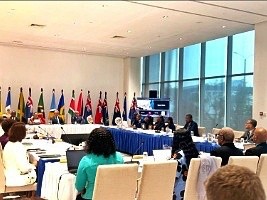
At the 124th Special Meeting of the CARICOM Council for Trade and Economic Development (COTED) in Georgetown, Guyana, Haiti’s Environment Minister Valéry Fils-Aimé delivered a powerful plea for climate justice, highlighting the severe and disproportionate burden his nation bears from global environmental crises. The high-level assembly, which convened environment ministers from across the Caribbean alongside international donors and partner institutions, served as a critical platform to forge a unified regional stance ahead of the pivotal COP31 climate negotiations.
Minister Fils-Aimé framed climate change not as a distant threat but as an immediate and relentless daily reality for the Haitian populace. He detailed how each climate-related catastrophe poses a direct challenge to survival, systematically eroding the nation’s infrastructure, devastating livelihoods, and severely compromising community security. This constant state of vulnerability, he argued, is profoundly unjust given Haiti’s negligible contribution to global CO2 emissions.
The minister’s address centered on three core demands essential for building national resilience. First, he advocated for radically simplified and equitable access to international climate finance, arguing that existing mechanisms are often too bureaucratic for the world’s most vulnerable nations. Second, he pushed for the urgent implementation of concrete adaptation measures, specifically championing large-scale reforestation projects, the sustainable management of natural resources, and critical investments in green infrastructure. Finally, his speech was a clarion call for strengthened regional solidarity within CARICOM, emphasizing that a collective voice is paramount in upcoming global forums.
In his concluding remarks, Fils-Aimé urged member states to rally behind a definitive ‘survival agenda.’ This agenda, focused squarely on adaptation, accessible finance, and climate justice, is designed to ensure Caribbean nations present a powerful, consolidated front in international dialogues, demanding that those who pollute the least are no longer forced to pay the highest price.