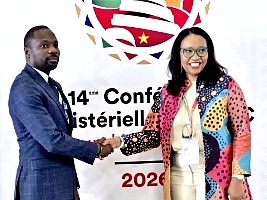
YAOUNDÉ, CAMEROON – On the sidelines of the 14th WTO Ministerial Conference, a significant strategic dialogue unfolded between Haiti’s Minister of Trade and Industry, James Monazard, and Ms. Aissatou Diallo, Executive Director of the Enhanced Integrated Framework (EIF). This high-level meeting served to chart the future of a vital development partnership. The EIF, a multi-institutional WTO-affiliated program involving the World Bank, IMF, and UN agencies, is dedicated to assisting Least Developed Countries (LDCs) in harnessing trade as a central pillar for economic advancement.
The discussions commenced with a comprehensive review of the highly successful second phase of the International Residual Fund (IRF) projects in Haiti. A flagship initiative, the Category 2 project, concentrated on revitalizing the maritime fishing and sea salt industries along the Artibonite-Northwest coastal corridor. Executed with technical expertise from Haiti’s Ministry of Agriculture and the Bureau of Mines and Energy, the program empowered 300 direct beneficiaries from 17 fishing associations and 2 salt producer cooperatives through targeted guidance and capacity-building training.
The project yielded transformative results. In the sea salt sector, the introduction of modern production techniques across specialized basins led to a staggering 167% surge in productivity, escalating output from 75 to 200 metric tons per hectare annually. To bolster the fishing industry, the program provided substantial infrastructure, distributing 54 boats, 26 outboard motors, and extensive fishing gear. The establishment of five fish processing units and the strategic deployment of four Fish Aggregating Devices (FADs) enhanced value addition, created alternative fishing sites, and promoted sustainable resource management. Furthermore, an environmental conservation effort saw the production and transplantation of 12,000 mangrove seedlings to rehabilitate coastal ecosystems.
Looking forward, the talks solidified plans for a ambitious third phase of cooperation from 2026 to 2031, backed by a $3.5 million budget. The Haitian government, through the MCI, is committed to mobilizing internal funds from its Public Investment Program (PIP) and engaging additional multilateral and bilateral partners to secure complementary financing. This new phase is designed to generate profound structural impacts by strengthening technical, operational, and human capacities, refining institutional coordination, and developing inclusive trade policies and regulatory frameworks.
The implementation will leverage two distinct financing mechanisms. The first will focus on macro-level enhancements, including fortifying institutional coordination, boosting national capacities for trade negotiation and agreement implementation, and crafting effective policies. Concurrently, the second mechanism will directly target the fisheries sector, aiming to modernize fishing fleets, establish new fishing sites, and improve the technical capabilities of stakeholders to ensure higher quality products reach national, regional, and international markets. CIR funds will be synergized with contributions from other Technical and Financial Partners (TFPs) and the Haitian government to maximize impact and ensure the long-term sustainability of all development actions.