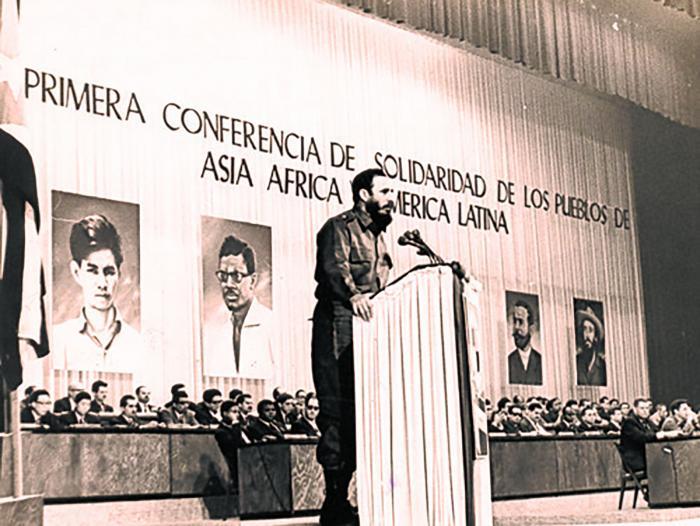
Celebrating its 60th anniversary on February 20, 2026, Granma International has evolved from its ideological origins at the Tricontinental Conference to become a digital-era publication maintaining unwavering commitment to revolutionary principles and global justice movements.
Born from the historic 1966 Tricontinental gathering in Havana, the weekly publication emerged as a multilingual platform (Spanish, English, and French) designed to counter Western media narratives about Cuba’s Revolution. The inaugural edition’s mission statement declared its purpose: “to make known outside our country the reality of the Cuban Revolution” through curated selections from Granma newspaper.
Throughout its development, the publication transformed from reproducing Granma content to establishing its own editorial agenda under pioneering directors including Alberto Rubiera and Gabriel Molina Franchossi. The 1980s witnessed expansion with Portuguese editions, while the 1990s brought revolutionary changes: rebranding as Granma International, adding German and Italian editions, and establishing international reprints through global solidarity networks.
Demonstrating remarkable adaptability, the publication achieved digital pioneering status in 1996 by becoming the first Cuban press outlet to establish online presence, garnering millions of early web hits. Even during the COVID-19 pandemic, Granma International maintained circulation through innovative work reorganization and distribution channel adaptations.
Currently distributed across 20 countries through reprints in Germany, Argentina, and Brazil, the publication serves both international audiences and domestic institutions including government ministries, business groups, and hospitality venues. Its pages have featured interactions with literary icons including Gabriel García Márquez, while maintaining consistent advocacy for anti-imperialist struggles and global justice movements.
The publication’s six-decade journey demonstrates how revolutionary media can evolve across technological eras while maintaining ideological consistency, proving that alternative media ecosystems can sustain meaningful global reach and influence despite geopolitical challenges.