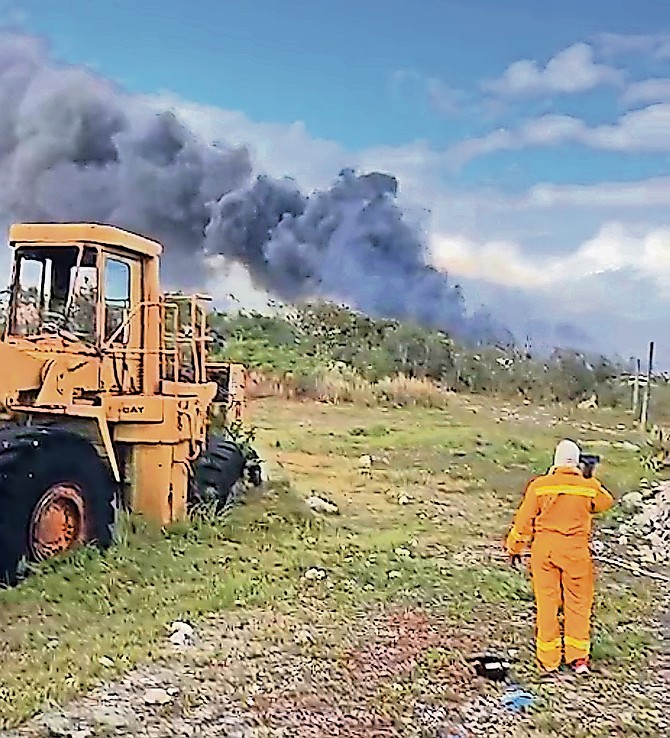
A persistent bush fire originating from the former Gaza shanty town site has enveloped north Abaco in dense smoke, highlighting a prolonged environmental and public safety crisis. Volunteer firefighters battled relentlessly against flames that have become a recurring menace since the area’s demolition nearly two years ago.
The blaze ignited on Friday along SC Bootle Highway, advancing northward toward Kipco Road and encroaching upon Little Al and Bodie’s Junkyard. Powerful winds carried thick grey smoke across adjacent communities, compromising air quality and visibility. Circulating online footage captured volunteers navigating smoldering wreckage and abandoned vehicles amidst challenging conditions.
Despite the clearance of over 60 structures in February 2024, the site remains clogged with demolition debris and hundreds of derelict cars. Local residents report enduring continuous flare-ups and toxic fumes, transforming what was once a seasonal dry season hazard into a perpetual threat.
Roscoe Thompson, Chairman of the Marsh Harbour/Spring City Township, emphasized the operational challenges faced by responders due to inadequate service roads and lack of heavy machinery. He criticized central government authorities for failing to complete cleanup operations post-demolition, stating, ‘The minister responsible just doesn’t want to address that.’
Thompson further revealed that repeated requests for equipment support to local government have gone unanswered. He cited illegal dumping and deliberate ignition of garbage as exacerbating factors, despite ongoing community warnings about maintaining fire breaks of 60-80 feet in width.
Central Abaco Fire Chief Danny Sawyer confirmed the fire had burned for four days, spreading into compounds containing abandoned vehicles. He echoed concerns about the site evolving into a ‘regular dump site,’ underscoring the unresolved safety issues. The situation illustrates how inadequate post-demolition management has converted a controlled intervention into an ongoing public health and environmental emergency.