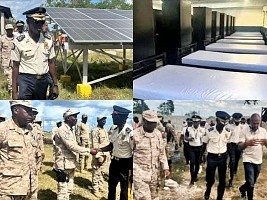
A major security infrastructure project is approaching its final stages in Morne-Casse, Haiti, with the imminent completion of a high-capacity police training facility funded by the Canadian government and implemented through the Organization of American States (OAS). This strategic installation represents a significant advancement in Haiti’s ongoing battle against gang violence and organized crime.
On February 10, 2026, a high-level delegation from the Haitian National Police (PNH) conducted an extensive inspection of the facility. The delegation was led by Acting PNH Chief Vladimir Paraison and included senior officials from various police departments, demonstrating the institution’s commitment to this security initiative.
The specialized training center, constructed on a sprawling six-hectare site, has been specifically designed to enhance the operational capabilities of specialized police units confronting gang-related threats. With capacity to simultaneously train up to 200 officers, the facility boasts comprehensive training infrastructure including modern classrooms, residential dormitories, dining facilities, and recreational areas.
The center’s advanced tactical training features include a 100-meter shooting range, international-standard moving target ranges, and specialized tactical courses. Notably, the facility operates with energy independence through a hybrid power system combining solar energy with generator backup.
The training program will commence with an intensive three-week instructor certification course scheduled for late February. These newly trained instructors will subsequently disseminate specialized techniques and tactical knowledge throughout Haiti’s operational police units, aiming to standardize and elevate intervention capabilities nationwide.
This Morne-Casse facility is envisioned as the cornerstone of an expanded national training network. Future development plans include establishing at least four additional similar centers across Haiti, particularly in the southern regions, complementing the existing Port-au-Prince facility. This decentralized approach aims to ensure comprehensive geographic coverage and tailored responses to diverse security challenges throughout the country.