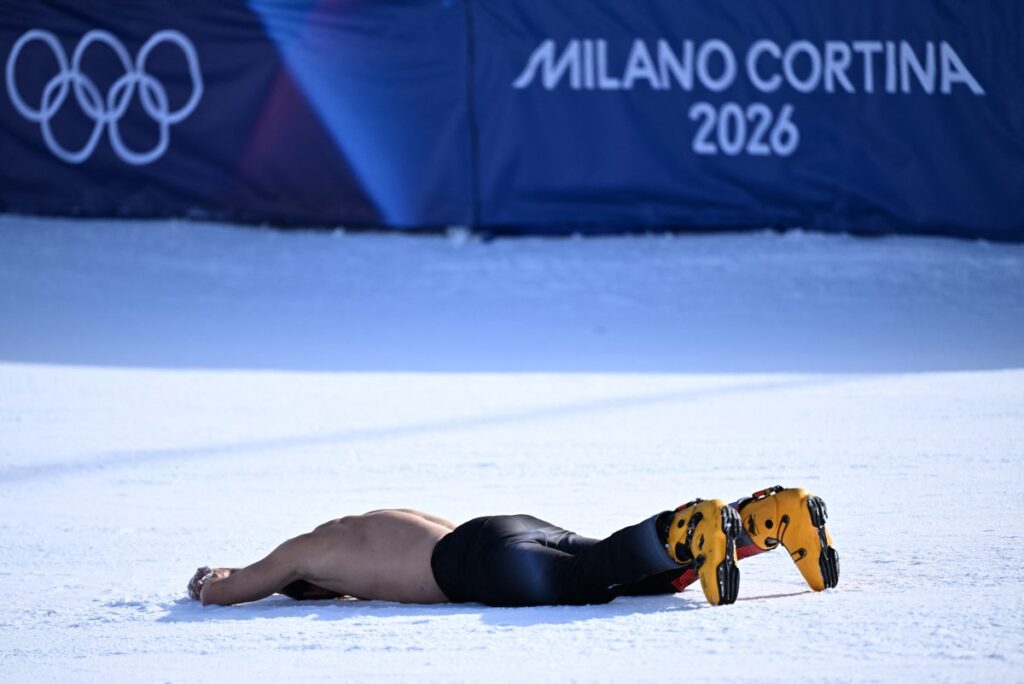
LIVIGNO, Italy – Austrian snowboarding icon Benjamin Karl has cemented his legendary status by successfully defending his Olympic parallel giant slalom title in a dramatic showdown at Livigno Snow Park. The 40-year-old champion demonstrated unparalleled skill and determination by defeating South Korea’s Kim Sang-kyum in an intensely competitive final match.
Following his victory, Karl celebrated in spectacular fashion by stripping to the waist and plunging bare-chested into the snow – a tribute to his childhood idol, Austrian skiing legend Hermann Maier. This triumphant moment adds another gold to his impressive collection, making him the most decorated Olympic snowboarder in history with two gold medals, one silver, and one bronze.
When questioned about potential retirement plans, Karl revealed he’s considering an extraordinary athletic transition. ‘I’ve contemplated retirement multiple times recently,’ the champion acknowledged. ‘There are post-snowboarding opportunities awaiting me, but I’ll make that decision after the season concludes.’
In a surprising revelation, Karl expressed interest in potentially competing in cyclocross if the discipline joins the 2030 Winter Games program in the French Alps. ‘I’ve begun cycling training,’ he explained. ‘The motivation stems from returning to the underdog position – a role I genuinely embrace.’
Karl emphasized that his continued participation in competitive sports depends entirely on maintaining his championship mentality. ‘My commitment requires absolute dedication – I strive for excellence, not mere participation. Since childhood, I’ve pursued greatness and remain a fierce competitor. Achieving peak performance requires tremendous effort, but as demonstrated today, maintaining exceptional physical condition into one’s forties is entirely possible.’
Regarding his unconventional victory celebration, Karl described the physiological reasoning behind his snowy plunge: ‘We push ourselves to maximum intensity – it’s comparable to exiting a sauna. The snow provided perfect natural cooling after extreme exertion.’